
|
|
|
|
#1
 01-15-2012, 08:43 AM
|
|||
|
|||

Quote:

|
|
#2
01-15-2012, 08:59 AM
|
|||
|
|||
|
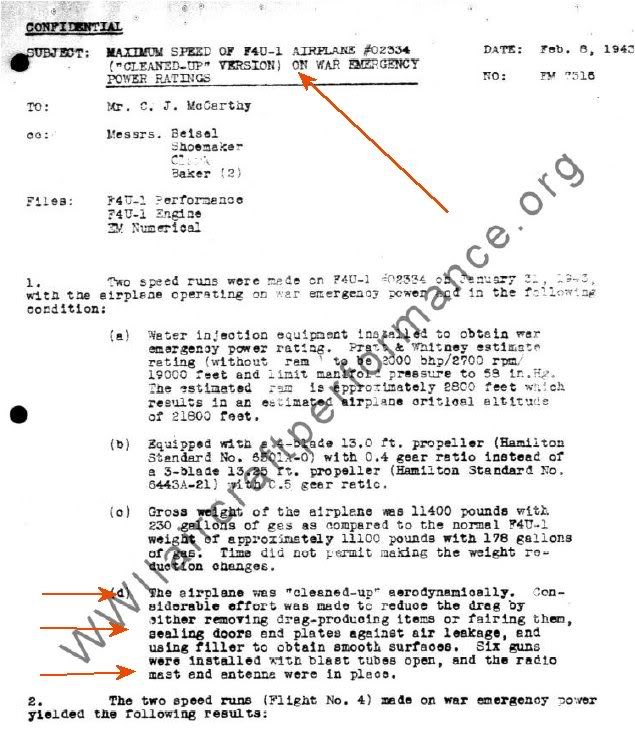
The season they did the tests in is irrelevant. It was probably done in Hawaii or somewhere in the southern part of the US where there is no winter. Besides... as I pointed out in an earlier post, this test was done early in 1943 on the earlier 1942 F4U-1s. After which the improvements were made and the C and D models were produced. Once again, refer to THIS document for the relevant test results on the 1944, 1945 C and D models we use in the sim:
http://www.wwiiaircraftperformance.org/f4u/f4u-1d-acp.pdf We need to stick to the facts here and not be assuming things that might or might not be a factor. These tests were conducted at different altitudes and weapon/fuel loadouts, but the planes were ALL loaded as the official documents clearly point out. Edit: Also if you notice at the bottom of that doc you will see "Water available for approximately 8.5 minutes at combat power". Wasn't the water cooling removed with 4.11 which causes it to overheat more quickly? Last edited by h0MbrE; 01-15-2012 at 09:13 AM.
|
|
#3
01-15-2012, 09:14 AM
|
|||
|
|||
|
Quote:
Actually, the rl report that you provided says it was -30/-32 degrees C for the runs. It does matter because temperature is modeled in the game on each map. That's why there are summer and winter versions, desert...etc. The airspeed are slower on the warm maps and faster on the cold ones. It has to do with density of the air. So if Ivank is test flying on a warm map he is going to get a slower non-comparable result. And if he is flying at a lower elevation than the real life (as he pointed out), he is going to get a slower result. Assuming everything was modeled in the ballpark. I would trust Ivank based on past experience.
|
 |
| Thread Tools | |
| Display Modes | |
|
|




 Hybrid Mode
