
|
|
#11
 06-07-2011, 09:58 PM
|
|||
|
|||

Quote:
The trials here: state: Quote:
[B] Dowding states: Quote:
The Merlin in Perspective, p.39, states that, at 3000 rpm, a bearing could run with the oil cut off for 15 seconds before the temp started to rise. Bearing failures in the early Merlins (p.36)were most likely to be caused by excessive rpm (3600rpm+) during prolonged dives at reduced power leading to oil starvation and due to improper design features which were corrected in later versions. 12lb/3000rpm operation was not a factor. Engine failures in flight are almost always due to fuel starvation due to improper engine management. It would be nice if you could provide some sources. 
|
|
#12
06-07-2011, 10:38 PM
|
||||
|
||||
|
Quote:
It is clearly stated in the instructions. Certainly the Technical Order is not so dismissive of the engines limitations or the modifications required as the Fighter Command appeal to higher for approval of the rating.  Reminds me of the whole 100/150 grade clownery. The Technical Branch says, it will hurt the engines while the operational side says we want the performance and we want it now. It lasted some 2 or 3 months in actual operational use in the 2nd TAF before maintenance issues forced the withdrawal completely.  Performance without reliability is no gain at all in aviation.
|
|
#14
06-07-2011, 11:01 PM
|
|||
|
|||
|
Quote:

|
|
#15
06-07-2011, 11:12 PM
|
|||
|
|||
|
Quote:
http://forum.1cpublishing.eu/showpos...0&postcount=73 it does not require grounding of the aircraft pending an engine inspection merely an assessment as whether or not an inspection is needed, which is exactly as the underlined portion of the memo states. Again, it almost seems that you are having a hard time translating english language documents. Regarding the 150 grade fuel issue, this is discussed here: http://www.wwiiaircraftperformance.o...rade-fuel.html in detail but this is not relevant here, and it is suffice to say that the use of 150 grade fuel continued until war's end. Last edited by Seadog; 06-07-2011 at 11:23 PM.
|
|
#16
06-07-2011, 11:31 PM
|
|||
|
|||
|
Quote:
Of course it turns out that you are referring to the USA's Federal Aviation Agency...  and trying to roll out civil aviation accident stats to support some kind of argument regarding the Battle of Britain and the use of supercharged engines in combat...!!!! and trying to roll out civil aviation accident stats to support some kind of argument regarding the Battle of Britain and the use of supercharged engines in combat...!!!!Simply unbelievable...  Maybe you have this confused with a MFS forum?
|
|
#17
06-08-2011, 01:03 AM
|
|||
|
|||
|
At least I had a good laugh
 Thx ! Thx !Perhaps you can understand now why a isolated pilot (not so) in the middle of the channel will only reluctantly use his emergency boost and why he wld be pleased to read in the plane log if the guy right before him has alrdy burnt the engine. By the way the IL2's 109 had a good eng damage model. Some adaptation wld seem necessary (like a random time length and an initial cte tracing the past use of boost by the player). Just my 2 cents...
|
|
#18
06-08-2011, 01:54 AM
|
||||
|
||||
|
Quote:
It does not matter whether you are Military or Civilian, you get off the ground under the same physical laws and restraints. Quote:
To translate that to non-pilots and A&P's....that means the aircraft is automatically grounded until a mechanic inspects the engine and returns it service.
|
|
#19
06-08-2011, 02:15 AM
|
||||
|
||||
|
Quote:
Here is my return trip this past weekend. ATC vectored me around that development off my right wing in the picture. Very Heavy precip with 1/2 inch hail....   
|
|
#20
06-08-2011, 02:55 AM
|
|||
|
|||
|
Quote:
The "language" does not state that and the pilot's notes for the Merlin III state: 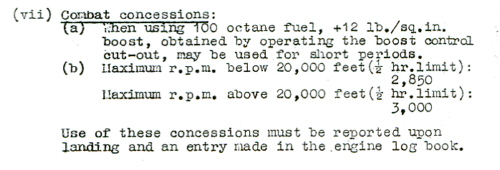 and this requires a pilot to log and report the use of combat power. Dowding's memo states: " 5. The consequences of exceeding the engine limitations are liable to manifest themselves on some subsequent occasion, perhaps during night flying or over the sea out or gliding distance from land. Pilots therefore, are to be instructed not to exceed; (i) Maximum specified temperatures for oil and engine coolant. (ii) Limit of 5 mins. for maximum of 3000 r.p.m. at 6.25 lbs/sq.in. or more. 6. It is in the interests of pilots themselves, when operations With the enemy may have resulted in engine limitations being exceeded, to acquaint the maintenance personnel with the facts, so that oil filters may be inspected at the first convenient opportunity to investigate whether damage to the bearings has resulted." "...first convenient opportunity..." during wartime is hardly grounded until inspected. and: http://www.wwiiaircraftperformance.org/ap1590b.jpg states "11. The use, in an emergency, of this high boost pressure is a definite overload condition on Merlin engine and therefore all occasions on which it is essential to make use of the + 12 lb must be reported by the pilot and recorded in the engine log book so that the engineer officer may be able to assess the reduction in life between overhauls and the need for special inspections. " "...recorded in the engine log book so that the engineer officer may be able to assess the reduction..." leaves it to the discretion of the engineer officer to decide whether an inspection is needed. In no way does this call for mandatory inspections. and none of these calls for grounding the aircraft until an inspection is made. Rather these call for assessments and inspections as needed depending on the entries in the log books and thus presumably the duration and circumstances under which 12lb/3000rpm was used. Dowding's memo specifically states that operation at 12lb/3000rpm for 5 minutes or less does not need to be reported to maintenance personnel. Again, the average life of a BofB RAFFC fighter was less than 2 months, so no one was unduly concerned about the use of 12lb/3000rpm in combat situations since the average fighter never survived long enough for engine life to be a major issue. Since about 1000 fighters were lost and something like 60,000 sorties were flown during the battle, the average RAFFC fighter probably had less than 100 hours on the clock when lost. Dowding's memo, for example, does not mention admin penalties for exceeding 5mins at 12lb/3000 rpm but merely states that they not do so, and to report the time when they do. Last edited by Seadog; 06-08-2011 at 08:28 AM.
|
 |
|
|





 Linear Mode

