
Fulqrum Publishing Home   |   Register   |   Today Posts   |   Members   |   UserCP   |   Calendar   |   Search   |   FAQ

Go Back   Official Fulqrum Publishing forum > Fulqrum Publishing > IL-2 Sturmovik: Cliffs of Dover > Technical threads > FM/DM threads

FM/DM threads Everything about FM/DM in CoD

Reply
 
Thread Tools Display Modes
  #1  
Old 06-08-2011, 01:54 AM
Crumpp's Avatar
Crumpp Crumpp is offline
Approved Member
 
Join Date: Feb 2008
Posts: 1,552
Default

Quote:
Most people reading this thread would have assume that you were referring to the Fleet Air Arm
You do understand that physics dictates the margins of safety for flight? A 1.5 Margin is the industry standard for anything that flies....

It does not matter whether you are Military or Civilian, you get off the ground under the same physical laws and restraints.

Quote:
It does not require grounding of the aircraft pending an engine inspection merely an assessment as whether or not an inspection is needed
The language is clear. A logbook entry in the maintenance logs followed by an inspection is required.

To translate that to non-pilots and A&P's....that means the aircraft is automatically grounded until a mechanic inspects the engine and returns it service.
Reply With Quote
  #2  
Old 06-08-2011, 02:15 AM
Crumpp's Avatar
Crumpp Crumpp is offline
Approved Member
 
Join Date: Feb 2008
Posts: 1,552
Default

Quote:
Perhaps you can understand now why a isolated pilot (not so) in the middle of the channel will only reluctantly use his emergency boost and why he wld be pleased to read in the plane log if the guy right before him has alrdy burnt the engine.
LOL, because he enjoys living!!

Here is my return trip this past weekend. ATC vectored me around that development off my right wing in the picture.

Very Heavy precip with 1/2 inch hail....


Reply With Quote
  #3  
Old 06-08-2011, 02:55 AM
Seadog Seadog is offline
Approved Member
 
Join Date: Jun 2011
Posts: 226
Default

Quote:
Originally Posted by Crumpp View Post


The language is clear. A logbook entry in the maintenance logs followed by an inspection is required.

To translate that to non-pilots and A&P's....that means the aircraft is automatically grounded until a mechanic inspects the engine and returns it service.

The "language" does not state that and the pilot's notes for the Merlin III state:
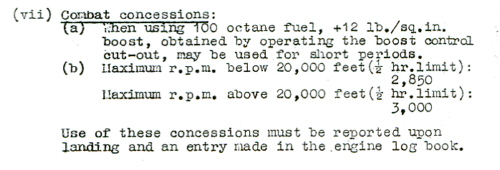

and this requires a pilot to log and report the use of combat power.

Dowding's memo states:

"
5. The consequences of exceeding the engine limitations are liable to manifest themselves on some subsequent occasion, perhaps during night flying or over the sea out or gliding distance from land. Pilots therefore, are to be instructed not to exceed;
(i) Maximum specified temperatures for oil and engine coolant.

(ii) Limit of 5 mins. for maximum of 3000 r.p.m. at 6.25 lbs/sq.in. or more.

6. It is in the interests of pilots themselves, when operations With the enemy may have resulted in engine limitations being exceeded, to acquaint the maintenance personnel with the facts, so that oil filters may be inspected at the first convenient opportunity to investigate whether damage to the bearings has resulted."


"...first convenient opportunity..." during wartime is hardly grounded until inspected.

and:
http://www.wwiiaircraftperformance.org/ap1590b.jpg
states

"11. The use, in an emergency, of this high boost pressure is a definite overload condition on Merlin engine and therefore all occasions on which it is essential to make use of the + 12 lb must be reported by the pilot and recorded in the engine log book so that the engineer officer may be able to assess the reduction in life between overhauls and the need for special inspections. "

"...recorded in the engine log book so that the engineer officer may be able to assess the reduction..." leaves it to the discretion of the engineer officer to decide whether an inspection is needed. In no way does this call for mandatory inspections.

and none of these calls for grounding the aircraft until an inspection is made. Rather these call for assessments and inspections as needed depending on the entries in the log books and thus presumably the duration and circumstances under which 12lb/3000rpm was used. Dowding's memo specifically states that operation at 12lb/3000rpm for 5 minutes or less does not need to be reported to maintenance personnel.

Again, the average life of a BofB RAFFC fighter was less than 2 months, so no one was unduly concerned about the use of 12lb/3000rpm in combat situations since the average fighter never survived long enough for engine life to be a major issue. Since about 1000 fighters were lost and something like 60,000 sorties were flown during the battle, the average RAFFC fighter probably had less than 100 hours on the clock when lost. Dowding's memo, for example, does not mention admin penalties for exceeding 5mins at 12lb/3000 rpm but merely states that they not do so, and to report the time when they do.

Last edited by Seadog; 06-08-2011 at 08:28 AM.
Reply With Quote
  #4  
Old 06-12-2011, 06:03 PM
Strike Strike is offline
Approved Member
 
Join Date: Jul 2010
Location: Norway
Posts: 684
Default

You know what I'd like to see? That would be really "original" and probably attract more "full-real" guys and let the rookies practice taking care of their planes?

I'd like a system where each fighter base has a set selection of planes.

As a player spawns the plane he selects is withdrawn from the pool and sent into action. (we already have server software that does this for IL-2)

If the player returns to base, this plane will be stored in it's current state (with all damage and wear) and put into maintenance or rearm/refuel rotation to bring it up to 100% again.

So now imagine you are pounding a base in an "all-out huge air-campaign online" server. The players that spawn from that base will eventually wear out their planes and decrease the operational effectivity of it.

In a base-capture scenario this would be essential so that the attackers won't feel that the defenders constantly spawn in 100% airplanes when so many have been "wounded" and limped back to base..

So back on topic to the original poster, this would create a chance that when you select your plane, it could be partially repaired or have significant wear on certain components due to damage and repairs/field-repairs giving it altered performance during the next missions.


It's just a piece of the larger idea of having more things play a role in the large ongoing campaign. Imagine airfields depending on factories to replenish them with brand new aircraft, ammo, fuel, spare parts etc so that it would be essential to protect these factories in order to keep the war going! Raiding trains/shipping would also cause the amount of supplies that make it to the frontline to decrease.

World war II online anybody? Yes, but in theory it could be applied with success here too

Last edited by Strike; 06-13-2011 at 10:42 AM.
Reply With Quote
  #5  
Old 06-12-2011, 11:56 PM
Blackdog_kt Blackdog_kt is offline
Approved Member
 
Join Date: Jan 2008
Posts: 2,715
Default

Quote:
Originally Posted by Crumpp View Post
That is good idea to reward game players who operate their virtual machine correctly.

Real pilots follow published procedures because they understand the engineering margins are narrow and the procedure is in place to get the best performance from your engine. The procedures are there for a reason, to keep your engine developing the maximum power it can deliver.

In the real world, the penalty for abusing your engine is reduced power and an increased risk of catastrophic failure. It should be the same in your game.

You start out with a given potential for maximum power and as you abuse the engine, that power potential is reduced. By the time you finish slamming the throttle, improper propeller use, mixture control use, supercharging gearing misuse, not adhering to temperature rates, and running the motor over-boosted, you could end up with a 900 hp engine at the end of the sortie. No funny noises, just a gradual loss of power. That means your performance will noticeably degrade as you abuse the engine. That loss would effect the airplanes combat performance.

It is not realistic to consider hours flown or previous abuse. It is a game and cannot simulate such things. You get one airplane and at the beginning of the sortie it is new. Depending on how you treat the engine you could land with the same power potential or you could land a worn out aircraft that is no longer combat effective.

This would have to be clearly published in the game manual along with "proper operating procedures" or the whining would be legendary.

Such a system would reward the players who understand their aircraft and can integrate proper operations with proper tactics. You would have a much better simulation of WWII air combat.
This is a good suggestion for "brand new aircraft each sortie" gameplay mode.


Quote:
Originally Posted by Strike View Post
You know what I'd like to see? That would be really "original" and probably attract more "full-real" guys and let the rookies practice taking care of their planes?

I'd like a system where each fighter base has a set selection of planes.

As a player spawns the plane he selects is withdrawn from the pool and sent into action. (we already have server software that does this for IL-2)

If the player returns to base, this plane will be stored in it's current state (with all damage and wear) and put into maintenance or rearm/refuel rotation to bring it up to 100% again.

So now imagine you are pounding a base in an "all-out huge air-campaign online" server. The players that spawn from that base will eventually wear out their planes and decrease the operational effectivity of it.

In a base-capture scenario this would be essential so that the attackers won't feel that the defenders don't constantly spawn in 100% airplanes when so many have been "wounded" and limped back to base..

So back on topic to the original poster, this would create a chance that when you select your plane, it could be partially repaired or have significant wear on certain components due to damage and repairs/field-repairs giving it altered performance during the next missions.


It's just a piece of the larger idea of having more things play a role in the large ongoing campaign. Imagine airfields depending on factories to replenish them with brand new aircraft, ammo, fuel, spare parts etc so that it would be essential to protect these factories in order to keep the war going! Raiding trains/shipping would also cause the amount of supplies that make it to the frontline to decrease.

World war II online anybody? Yes, but in theory it could be applied with success here too
And this is exactly what i had in mind in terms of how a dynamic campaign should be handled in the future, offline or online. In fact, this might already be possible for someone who knows how to code in C#.

Great suggestions in both cases
Reply With Quote
  #6  
Old 06-15-2011, 07:50 PM
Seadog Seadog is offline
Approved Member
 
Join Date: Jun 2011
Posts: 226
Default Inspections

In Nov 1940, the Merlin XX was given "official" approval to use 12lb/3000rpm but strip inspections were not required after its use:
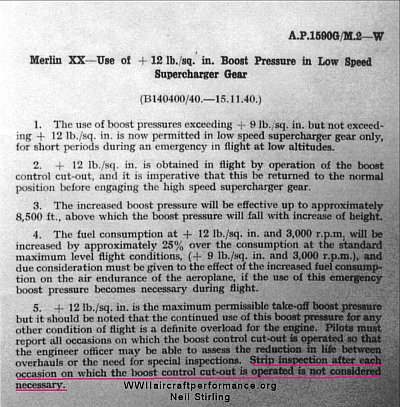

The Merlin 60 series engines were cleared for 15 and 18lb boost for combat and again strip inspections were not required after use:


An oil filter check was recommended, which probably took about 10mins.

The above data is from the Spit 9 Pilot's notes and from a Merlin 60 series maintenance manual.

Last edited by Seadog; 06-15-2011 at 08:56 PM.
Reply With Quote
  #7  
Old 06-15-2011, 10:35 PM
ICDP ICDP is offline
Approved Member
 
Join Date: Oct 2007
Posts: 157
Default

Quote:
Originally Posted by Seadog View Post
In Nov 1940, the Merlin XX was given "official" approval to use 12lb/3000rpm but strip inspections were not required after its use:

The Merlin 60 series engines were cleared for 15 and 18lb boost for combat and again strip inspections were not required after use:

An oil filter check was recommended, which probably took about 10mins.

The above data is from the Spit 9 Pilot's notes and from a Merlin 60 series maintenance manual.
Meaning that at some stage prior to the Merlin XX was introduced strip inspections were required after overboost was used. Good info, it seems +12lbs boost on the Merlin II, III and XII was limited to a short amount of time... oh I don't know, 5 minutes maybe
Reply With Quote
Reply


Posting Rules
You may not post new threads
You may not post replies
You may not post attachments
You may not edit your posts

BB code is On
Smilies are On
[IMG] code is On
HTML code is Off

Forum Jump


All times are GMT. The time now is 11:00 PM.


Powered by vBulletin® Version 3.8.4
Copyright ©2000 - 2026, Jelsoft Enterprises Ltd.
Copyright © 2007 Fulqrum Publishing. All rights reserved.