Fulqrum Publishing Home   |   Register   |   Today Posts   |   Members   |   UserCP   |   Calendar   |   Search   |   FAQ

Go Back   Official Fulqrum Publishing forum > Fulqrum Publishing > IL-2 Sturmovik: Cliffs of Dover > Technical threads > FM/DM threads

FM/DM threads Everything about FM/DM in CoD

Closed Thread
 
Thread Tools Display Modes
  #1  
Old 07-19-2012, 08:21 AM
winny winny is offline
Approved Member
 
Join Date: Sep 2009
Location: Manchester UK
Posts: 1,508
Default

Quote:
Originally Posted by Crumpp View Post
Spitfire Mk I Operating Notes, July 1940.

What do you think the "violent shudder" is.....hint....PRE-STALL BUFFET.

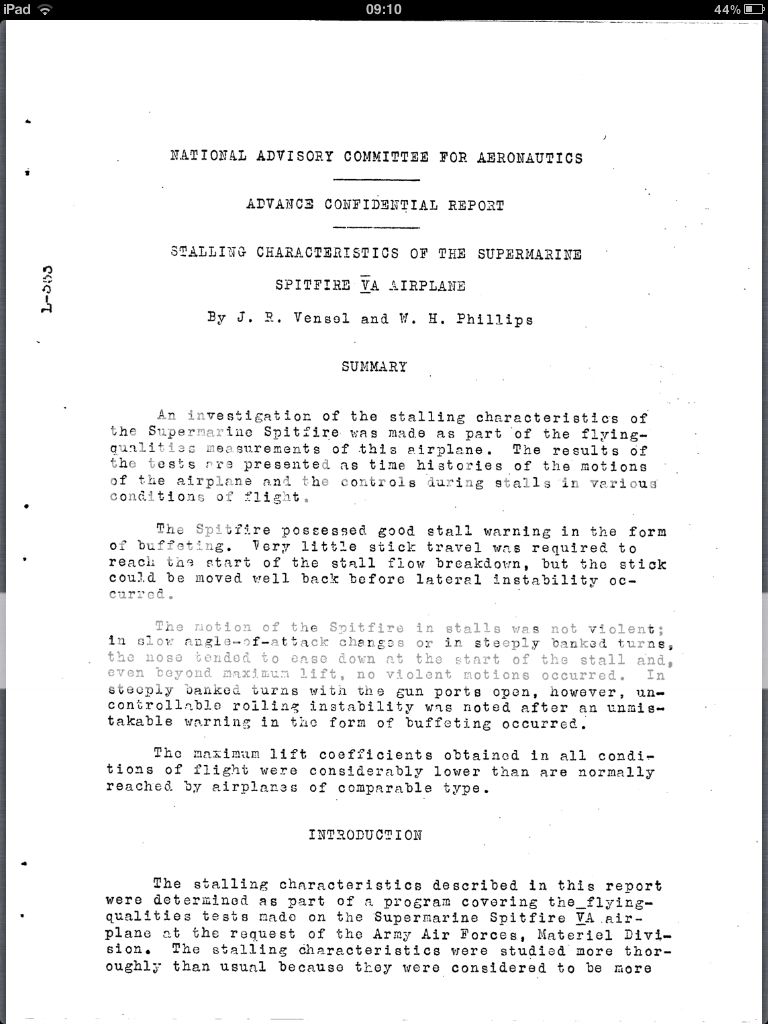
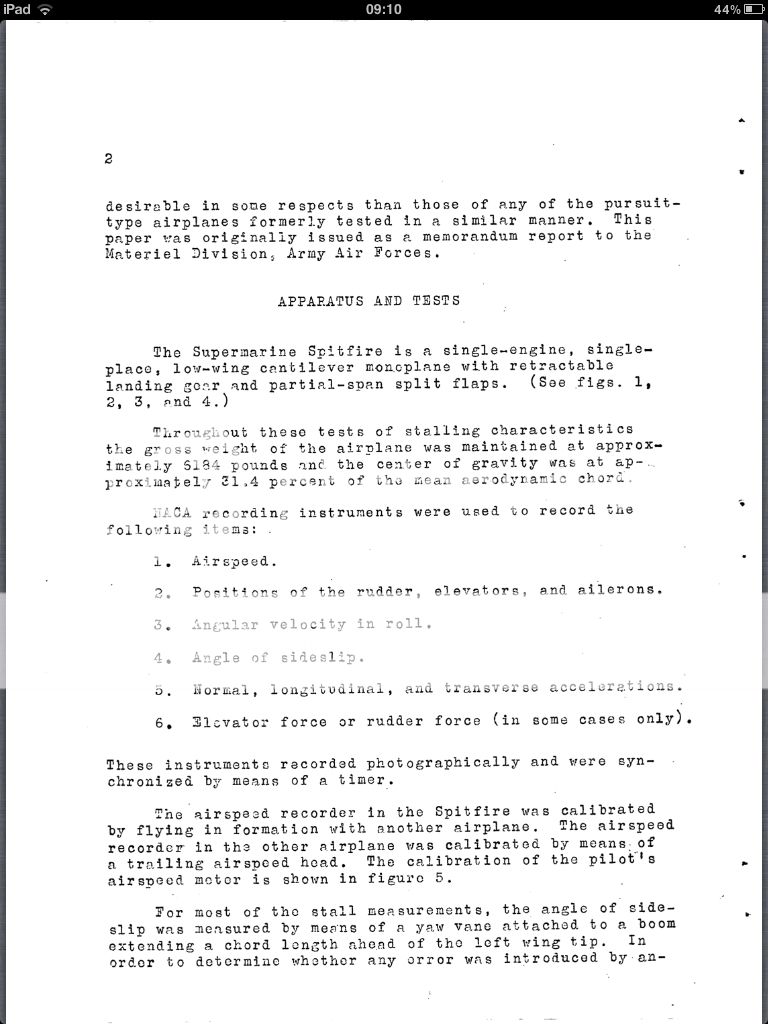
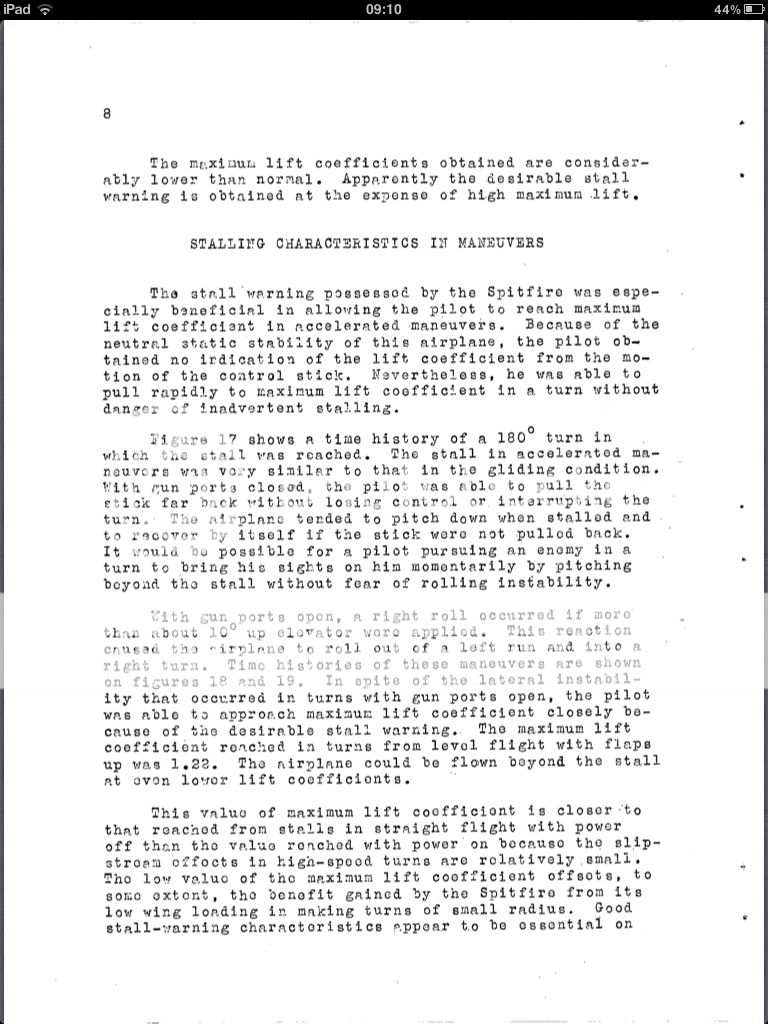
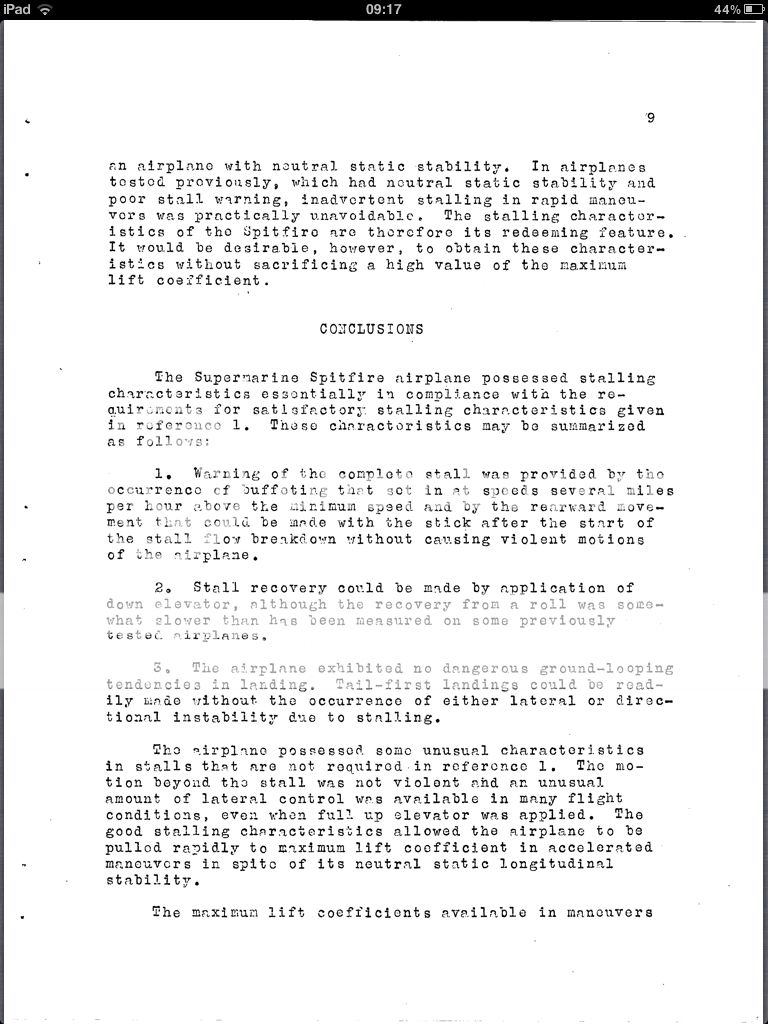
Ok.. NACA report on stalling characteristics of the same MK V


Further on in the report


  #2  
Old 07-19-2012, 04:10 PM
lane lane is offline
Approved Member
 
Join Date: Nov 2008
Posts: 141
Default

Quote:
Originally Posted by winny View Post
Ok.. NACA report on stalling characteristics of the same MK V


Further on in the report


Nice post winny. See also related R.A.E. Technical Note No.Aero 1106 - Comments on N.A.C.A. Advance Confidential Report Nos.A.R.C. 6423 and 6422 - "Stalling charteristics of a Supermarine Spitfire VA airplane" and "Measurments of the flying qualities of a Supermarine Spitfire VA airplane"
  #3  
Old 07-19-2012, 04:14 PM
lane lane is offline
Approved Member
 
Join Date: Nov 2008
Posts: 141
Default

Spitfire I K-9787 & K-9788 were tested by A. & A.E.E. and a report issued in June 1939 on Fuel consumption tests, handling and diving trials.

Longitudinal stability was measured and records attached to the report: Fig 3. Stability Records

Regarding stability:


Control and stability at the stall was tested in accordance with standards stipulated in A.D.M.293. The Spitfire I handling was found satisfactory and the aircraft deemed fit for service use. Of particular note it was concluded that during acrobatics: "Loops, half rolls off loops, and slow rolls have been done. These manoeuvres are easy to make and the aeroplane behaves quite normally in all of them."
  #4  
Old 07-19-2012, 04:19 PM
CaptainDoggles's Avatar
CaptainDoggles CaptainDoggles is offline
Approved Member
 
Join Date: Jun 2011
Posts: 1,198
Default

Thanks for posting, Lane.

Quote:
Longitudinally, the aircraft is stable with centre of gravity forward, but is unstable with centre of gravity normal and aft with engine 'OFF' and 'ON'.
So at normal CG, the A&AEE concludes that the aircraft is longitudinally unstable. I'm sure certain characters will try to wriggle out of this one, but it seems open-and-shut to me. I'm sure we will be deluded with marginally-relevant allusions to British aerodynamics pioneers, and pilot quotes saying that the Spitfire was a dream to fly. Nobody's saying it wasn't a good aircraft.

Seeing people describe this thread as a "character assassination" has been amusing.

Last edited by CaptainDoggles; 07-19-2012 at 04:23 PM.
  #5  
Old 07-19-2012, 04:30 PM
taildraggernut taildraggernut is offline
Approved Member
 
Join Date: Mar 2012
Posts: 334
Default

Quote:
Originally Posted by CaptainDoggles View Post
Thanks for posting, Lane.


So at normal CG, the A&AEE concludes that the aircraft is longitudinally unstable. I'm sure certain characters will try to wriggle out of this one, but it seems open-and-shut to me. I'm sure we will be deluded with marginally-relevant allusions to British aerodynamics pioneers, and pilot quotes saying that the Spitfire was a dream to fly. Nobody's saying it wasn't a good aircraft.

Seeing people describe this thread as a "character assassination" has been amusing.
Appart from ACE there, can you quote 'anybody' that said the Spit was not unstable?

No I didn't think so, in fact nobody is denying it, the instability is 'not' the apparent problem that Crumpp is trying to emphasise, the Mustang was longitudinaly unstable, heres an example where you needed to take your own advice and pay attention to what people write.
  #6  
Old 07-19-2012, 04:39 PM
CaptainDoggles's Avatar
CaptainDoggles CaptainDoggles is offline
Approved Member
 
Join Date: Jun 2011
Posts: 1,198
Default

Quote:
Originally Posted by taildraggernut View Post
Appart from ACE there, can you quote 'anybody' that said the Spit was not unstable?
In fact, yes I can.

Here:

Quote:
Originally Posted by NZtyphoon View Post
Crumpp is putting a worst-case scenario on the "buffeting"

...

in other threads he has gone as far as to claim that early Spitfires were longitudinally unstable and dangerous to fly
Quote:
Originally Posted by NZtyphoon View Post
Now, until Crumpp, or anyone else, can prove beyond reasonable doubt that NACA got their cg calculations right there is a question mark over the longitudinal stability of this Spitfire VA as tested.
Quote:
Originally Posted by Fenrir View Post
The NACA test discovered what they discovered - I can't argue with their findings, FOR ONE PARTICULAR AIRCRAFT. However I cannot agree that these are representative of the breed.
--

Quote:
No I didn't think so
Foot in mouth, etc.

Now let's stop this silly derailment of this thread and stay on topic
  #7  
Old 07-19-2012, 04:41 PM
taildraggernut taildraggernut is offline
Approved Member
 
Join Date: Mar 2012
Posts: 334
Default

Quote:
Originally Posted by CaptainDoggles View Post
In fact, yes I can.

Here:
Foot in mouth, etc.
Sorry no cigar, only NZTyphoons quotes actually mentions stability and even then it is more emphasis on the dangerous to fly part, which clearly the Spitfire was not dangerous to fly...at all.

Last edited by taildraggernut; 07-19-2012 at 04:45 PM.
  #8  
Old 07-19-2012, 04:45 PM
ATAG_Dutch ATAG_Dutch is offline
Approved Member
 
Join Date: Feb 2010
Posts: 1,793
Default

So with a full tank, trimmed for level flight, pulling back on the stick then releasing to neutral would return the aircraft to level flight.

With a half full tank in the same conditions, pulling back on the stick would need a push on the stick to return to normal flight, and a bigger push when the tank is near empty.

That's my simplistic understanding of longitudinal stability or not as the case may be.

All modern military aircraft are designed with inherent instability which requires a computer to control. Instability is necessary for manoeuvrability.

I totally fail to see the point in this thread, other than to ask the devs to model a changing CofG and longitudinal stability according to fuel load. Is that the point?

Last edited by ATAG_Dutch; 07-19-2012 at 04:48 PM.
  #9  
Old 07-19-2012, 04:51 PM
CaptainDoggles's Avatar
CaptainDoggles CaptainDoggles is offline
Approved Member
 
Join Date: Jun 2011
Posts: 1,198
Default

Quote:
Originally Posted by ATAG_Dutch View Post
I totally fail to see the point in this thread, other than to ask the devs to model a changing CofG and longitudinal stability according to fuel load. Is that the point?
Here's a simple example from the game: Right now, to hold a turn in the spit you have to hold the stick back a significant amount.

In reality, after initiating the turn I believe it was necessary to relax your pressure on the stick (move it closer to center). Otherwise, the aircraft could tighten its turn, and if you are above corner speed that means it would be easy to inadvertently exceed the G limits and damage the airframe.

There's a quote I remember reading from a pilot who said he actually had to push the stick almost all the way forward to hold a turn, because the aircraft kept wanting to tighten up.

--

I also think that the very light stick forces and (lack of) control harmonization should be modeled.
  #10  
Old 07-19-2012, 04:51 PM
winny winny is offline
Approved Member
 
Join Date: Sep 2009
Location: Manchester UK
Posts: 1,508
Default

I have another question, the RAE refer to the bf-109 as being " too stable for a fighter".

So is instability a good or bad thing?
Closed Thread

Thread Tools
Display Modes

Posting Rules
You may not post new threads
You may not post replies
You may not post attachments
You may not edit your posts

BB code is On
Smilies are On
[IMG] code is On
HTML code is Off

Forum Jump


All times are GMT. The time now is 03:43 AM.


Powered by vBulletin® Version 3.8.4
Copyright ©2000 - 2026, Jelsoft Enterprises Ltd.
Copyright © 2007 Fulqrum Publishing. All rights reserved.