
|
|
|||||||
| FM/DM threads Everything about FM/DM in CoD |
 |
|
|
Thread Tools | Display Modes |
|
#231
 05-15-2012, 11:32 PM
|
|||
|
|||

The question is now:
would, if the FM was set to cut out at 0.1g, the acceleration measured ingame at the same place as in RL corresond to 0.1g? I do not know but I could well imagine that what is shown as 0.5g ingame as acceleration is something different from what was measured during the RL flight trials and might just not correspond to 0.5g in RL. So perhaps the 0.5g could well correspond to the RL 0.1g case (tbc by devs). At least at this moment we cannot exclude as we do not know how the ingame acceleration is obtained. Are we also sure that the ingame acceleration given is the acceleration in the symmetrical plane of the aircraft? or just a lateral acceleration hence including side forces?. 
|
|
#232
05-15-2012, 11:46 PM
|
|||
|
|||
|
Quote:
I agree that historically pilots did not just push the stick forward, they would bank and dive away in a diving turn (just like in the movies) or even split S. However the complaints seem to be that the cutoff occurs even in normal flight.
|
|
#234
05-16-2012, 12:42 AM
|
|||
|
|||
|
A second related document is in the UK National Archives "AVIA 18/1281 Tests of RAE devices for the reduction of "Negative G" engine cutting on merlin engined fighter aircraft". This document details flight test data on 3 devices (Including the Schilling orifice ... though its called the RAE Restrictor .... PC in action back in the 40's).
It compares each of the devices to an unmodified aircraft. In the tables presented the G used to induce cutout are in the order of -0.5G up to -1.5G. Though emphasis of the document is on the time taken to recover from cutout rather than preventing it, despite the document title. Given the document is not looking at specifically preventing cutout itself but rather minimising the time of the cutout it needs to be put into perspective when using it to decide on initial cutout values. However it is of interest (imo) that reasonable values of Negative G were used (i.e. significantly less than 0G) in all the tests.... i.e. not just smooth nose position changes. In our discussion here we are only interested in unmodified systems. The jpg below is from the document referring to an unmodified or "Normal Fuel System" aeroplane 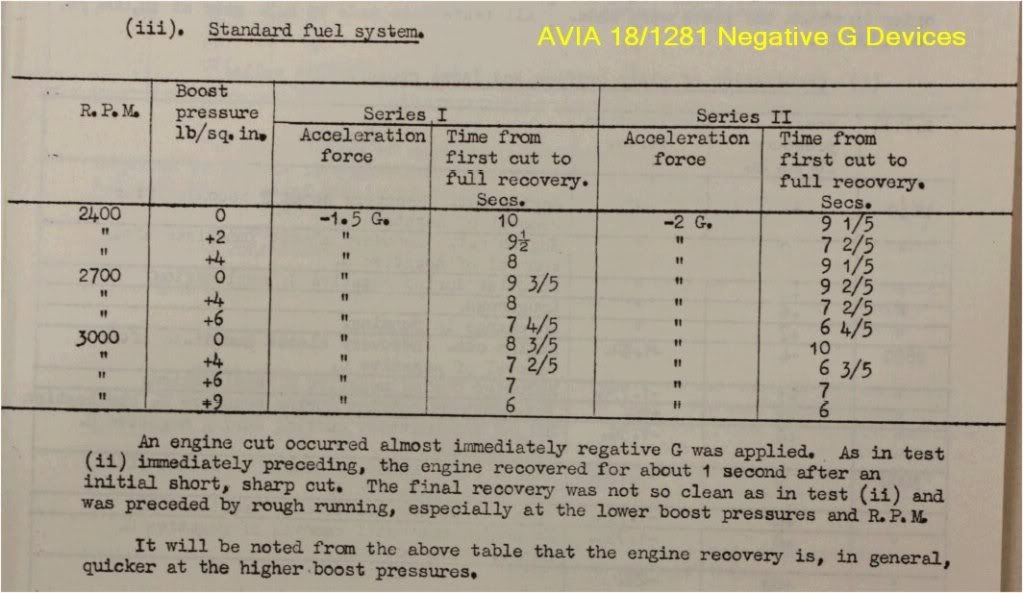
Last edited by IvanK; 05-16-2012 at 12:47 AM.
|
|
#235
05-16-2012, 01:29 AM
|
||||
|
||||
|
That document clearly states:
Quote:
No wonder the Luftwaffe makes note of the effectiveness of bunting.
|
|
#236
05-16-2012, 01:36 AM
|
||||
|
||||
|
Quote:
In the sim the engine will frequently cut out when making fine adjustments to trim in level flight -- which seems a tad excessive.
__________________

|
|
#237
05-16-2012, 02:04 AM
|
|||
|
|||
|
Quote:
The "Shilling Orifice" did not actually fix the problem, just delayed its onset a few seconds. Sustained inverted flight was still impossible in a Shilling equipped Spitfire, that required a pressure carburetor. Last edited by WTE_Galway; 05-16-2012 at 02:07 AM.
|
|
#239
05-16-2012, 06:11 AM
|
||||
|
||||
|
Quote:
cur_Plane.getParameter(part.ParameterTypes.Z_Overl oad, 0); is acceleration in the fore/aft plane cur_Plane.getParameter(part.ParameterTypes.Z_Overl oad, 1); is acceleration in the lateral plane cur_Plane.getParameter(part.ParameterTypes.Z_Overl oad, 2); is acceleration in the vertical plane, renamed G-force on the chart. At the moment of the 0.5G cut there were very small fore/aft and lateral g-forces of -0.04g and +0.02g respectively (slight speed reduction and slight sideslip). Its close enough to indicate that the cutout occurs well before 0.1G. Readings were taken every 300 mSecs. Unfortunately we cannot add instruments to the cockpit so we can only draw data from the game parameters.
__________________
klem 56 Squadron RAF "Firebirds" http://firebirds.2ndtaf.org.uk/  ASUS Sabertooth X58 /i7 950 @ 4GHz / 6Gb DDR3 1600 CAS8 / EVGA GTX570 GPU 1.28Gb superclocked / Crucial 128Gb SSD SATA III 6Gb/s, 355Mb-215Mb Read-Write / 850W PSU Windows 7 64 bit Home Premium / Samsung 22" 226BW @ 1680 x 1050 / TrackIR4 with TrackIR5 software / Saitek X52 Pro & Rudders
|
|
#240
05-16-2012, 05:55 PM
|
|||
|
|||
|
Quote:
|
|
| Thread Tools | |
| Display Modes | |
|
|






 Linear Mode

