
Fulqrum Publishing Home   |   Register   |   Today Posts   |   Members   |   UserCP   |   Calendar   |   Search   |   FAQ

Go Back   Official Fulqrum Publishing forum > Fulqrum Publishing > IL-2 Sturmovik: Cliffs of Dover > Technical threads > FM/DM threads

FM/DM threads Everything about FM/DM in CoD

Reply
 
Thread Tools Display Modes
  #1  
Old 05-16-2012, 12:42 AM
IvanK IvanK is offline
Approved Member
 
Join Date: Oct 2007
Location: Australia
Posts: 886
Default

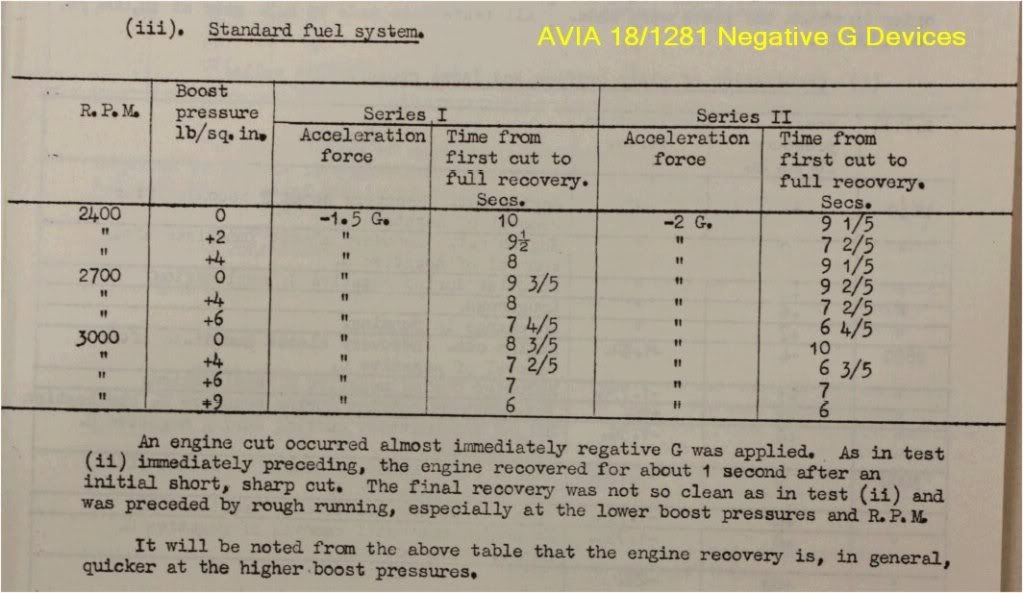
A second related document is in the UK National Archives "AVIA 18/1281 Tests of RAE devices for the reduction of "Negative G" engine cutting on merlin engined fighter aircraft". This document details flight test data on 3 devices (Including the Schilling orifice ... though its called the RAE Restrictor .... PC in action back in the 40's).

It compares each of the devices to an unmodified aircraft. In the tables presented the G used to induce cutout are in the order of -0.5G up to -1.5G. Though emphasis of the document is on the time taken to recover from cutout rather than preventing it, despite the document title.

Given the document is not looking at specifically preventing cutout itself but rather minimising the time of the cutout it needs to be put into perspective when using it to decide on initial cutout values. However it is of interest (imo) that reasonable values of Negative G were used (i.e. significantly less than 0G) in all the tests.... i.e. not just smooth nose position changes.

In our discussion here we are only interested in unmodified systems. The jpg below is from the document referring to an unmodified or "Normal Fuel System" aeroplane

Last edited by IvanK; 05-16-2012 at 12:47 AM.
Reply With Quote
  #2  
Old 05-16-2012, 01:29 AM
Crumpp's Avatar
Crumpp Crumpp is offline
Approved Member
 
Join Date: Feb 2008
Posts: 1,552
Default

That document clearly states:

Quote:
An engine cut out occurred almost immediately negative G was applied.
Pretty clear cut but I am surprised at the amount of time it took for the Merlin to recover, 6-10 seconds and averaging ~8 seconds.

No wonder the Luftwaffe makes note of the effectiveness of bunting.
Reply With Quote
  #3  
Old 05-16-2012, 02:04 AM
WTE_Galway WTE_Galway is offline
Approved Member
 
Join Date: Jul 2008
Posts: 1,207
Default

Quote:
Originally Posted by IvanK View Post
A second related document is in the UK National Archives "AVIA 18/1281 Tests of RAE devices for the reduction of "Negative G" engine cutting on merlin engined fighter aircraft". This document details flight test data on 3 devices (Including the Schilling orifice ... though its called the RAE Restrictor .... PC in action back in the 40's).

It compares each of the devices to an unmodified aircraft. In the tables presented the G used to induce cutout are in the order of -0.5G up to -1.5G. Though emphasis of the document is on the time taken to recover from cutout rather than preventing it, despite the document title.
Its worth pointing out that the Shilling modifications (which involved more than just fitting the famous flow constrictor) main effect was to substantially delay the onset of the second stage flooding cut-off. The shilling orifice was a stopgap.

The "Shilling Orifice" did not actually fix the problem, just delayed its onset a few seconds. Sustained inverted flight was still impossible in a Shilling equipped Spitfire, that required a pressure carburetor.

Last edited by WTE_Galway; 05-16-2012 at 02:07 AM.
Reply With Quote
  #4  
Old 05-16-2012, 02:24 AM
Crumpp's Avatar
Crumpp Crumpp is offline
Approved Member
 
Join Date: Feb 2008
Posts: 1,552
Default

Quote:
which seems a tad excessive.
What you need is a G meter. That does seem kind of excessive. I got the game and can check it out.
Reply With Quote
  #5  
Old 05-15-2012, 10:47 PM
Sutts Sutts is offline
Approved Member
 
Join Date: Jan 2010
Posts: 566
Default

Quote:
Originally Posted by klem View Post
I did some tests using a modified version of a script called BlackBox which I found elsewhere on the forums to capture the RPM cut and G value.

Chart is attached. It seems the cutout is set to 0.5G and seems instantaneous. You can see the 'highest' G-value cut, the third red line from the left. Others are just more examples. 0.1G it definitely ain't.

The chart shows RPM vs G-force and the G-cut is easily seen just before the characteristic RPM overshoot that occurs after it recovers.

You Merlin flyers need to vote on this unless its already in hand. Many very minor bugs and features have more votes than this.
http://www.il2bugtracker.com/issues/230

Great work klem. Are you going to add this to the top section of the bug tracker report?...had a quick look but couldn't see it. Cheers.
Reply With Quote
Reply

Thread Tools
Display Modes

Posting Rules
You may not post new threads
You may not post replies
You may not post attachments
You may not edit your posts

BB code is On
Smilies are On
[IMG] code is On
HTML code is Off

Forum Jump


All times are GMT. The time now is 03:41 AM.


Powered by vBulletin® Version 3.8.4
Copyright ©2000 - 2026, Jelsoft Enterprises Ltd.
Copyright © 2007 Fulqrum Publishing. All rights reserved.