
|
|
#201
 09-18-2012, 07:07 PM
|
|||
|
|||

how was that patronising drivel?
that was just plain rude. also on the ignore list, im ouita this conversation. leave to your 2 oversized ego's I wish we were having this conversation in the pub, I woulda bashed you both out by now. 
|
|
#202
09-18-2012, 07:10 PM
|
||||
|
||||
|
Quote:
__________________
 Intel Q9550 @3.3ghz(OC), Asus rampage extreme MOBO, Nvidia GTX470 1.2Gb Vram, 8Gb DDR3 Ram, Win 7 64bit ultimate edition Last edited by bongodriver; 09-18-2012 at 07:13 PM.
|
|
#203
09-18-2012, 07:12 PM
|
||||
|
||||
|
Quote:
__________________
Intel Q9550 @3.3ghz(OC), Asus rampage extreme MOBO, Nvidia GTX470 1.2Gb Vram, 8Gb DDR3 Ram, Win 7 64bit ultimate edition
|
|
#205
09-18-2012, 07:43 PM
|
||||
|
||||
|
Quote:
Kurfurst said of the Spit in his scenario 'can hardly turn at all'......but why would the aircraft suddenly not be able to turn any more?......it in fact will continue to turn quite happily, what it won't do is sustain speed.
__________________
Intel Q9550 @3.3ghz(OC), Asus rampage extreme MOBO, Nvidia GTX470 1.2Gb Vram, 8Gb DDR3 Ram, Win 7 64bit ultimate edition
|
|
#207
09-18-2012, 08:04 PM
|
||||
|
||||
|
Quote:

__________________
Intel Q9550 @3.3ghz(OC), Asus rampage extreme MOBO, Nvidia GTX470 1.2Gb Vram, 8Gb DDR3 Ram, Win 7 64bit ultimate edition
|
|
#208
09-18-2012, 10:35 PM
|
|||
|
|||
|
Quote:
RAE Chart from AVIA 6/2394 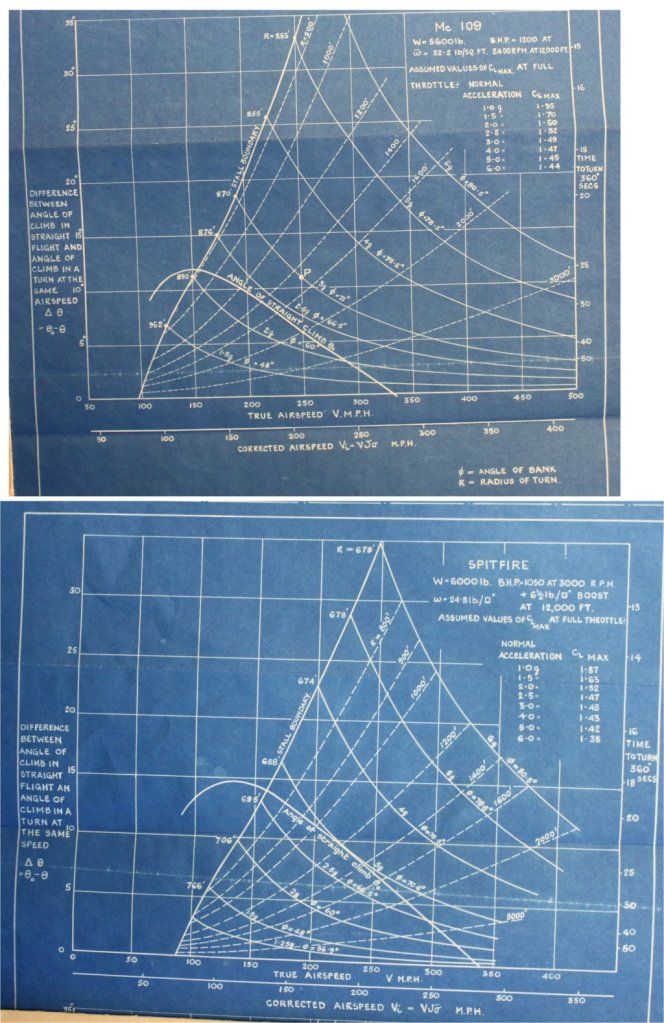 Crumpp chart:  Dont see any parameters/conditions/assumptions used on your chart either Crumpp Who is right RAE or Crumpp ? Last edited by IvanK; 09-18-2012 at 11:20 PM.
|
|
#209
09-19-2012, 01:23 AM
|
||||
|
||||
|
Quote:
The RAE chart is at 12,000 feet and was taken off one data point. It did puzzle me as our radius and other data aligns. It puzzled me until I stated getting into the details of the chart. According to that chart, the Spitfire Mk 1 is capable of reaching 340mph (+) at 12,000 feet on 1050 bhp. The RAE graph found in AVIA 6/2394 is a performance estimate from September 1940. A flight report from March 1940 gives the power at 12,000 feet: Quote:
http://www.spitfireperformance.com/n3171.html The AVIA 6/2394 does not fit the only +12lbs estimate we have for level speeds. http://www.spitfireperformance.com/s...-rae-12lbs.jpg This estimate shows 359mph TAS at 12,000 feet. That is over a 5% error from the speed found in AVIA 6/2394. It would be unusual for such a large estimate error in an established design. I don't know what Spitfire data they used but I suspect it was for an improved high altitude version as we saw before in a similar report previously posted on these forums in which you were involved in the discussion. All that can be said is we don't know the details and the ones we do know, do not fit any existing service model at the time. When we plug in the data from the Spitfire Mk I serving in the RAF during the BoB, we get a different result. Another anomaly is the CLmax. In order to get a CLmax of 1.87 on the Spitfire, you have to drop the stall speed far below what the Spitfire POH list's to a scant 62 knots. At the 76mph Vs (69mph IAS Vs + 7mph PEC) found in the POH, we get a CLmax of 1.69 which is far below the 1.87 Gates uses in the report. I am pretty sure Gates was not using a standard Spitfire Mk I for his base data in the estimate. It does not align with one. Calculate Sea level CL max: CL = Lift/(dynamic pressure * Reference Area) Dynamic Pressure = density ratio * Velocity^2 / 295 Dynamic pressure = (1 * 66^2)/295 = 14.76610169psf CL = 6050lbs / (14.76610169psf * 242sqft) = 1.693067034 Lift = CLqS Lift = 1.87 * 14.76610169psf * 242sqft = 6682 lbs of Lift generated.
__________________

|
|
#210
09-19-2012, 03:03 AM
|
|||
|
|||
|
"I don't know what Spitfire data they used but I suspect it was for an improved high altitude version as we saw before in a similar report previously posted on these forums in which you were involved in the discussion.
All that can be said is we don't know the details and the ones we do know, do not fit any existing service model at the time." "Normal B.H.P 950/990 at Rated Altitude 12,250 ft ' Garbage ! you are confusing rated power at 2600RPM with maximum power at 3000RPM. Here are 2 inspection test certificates for 2 different Spitfire MKI's one with a Merlin II the other with Merkin III. As you can see Max power is 1030hp at 16,250ft. at 6.25lbs boost 3000RPM. The RAE chart references 1050hp at 6.25lbs Boost 3000RPM at 12,000ft. 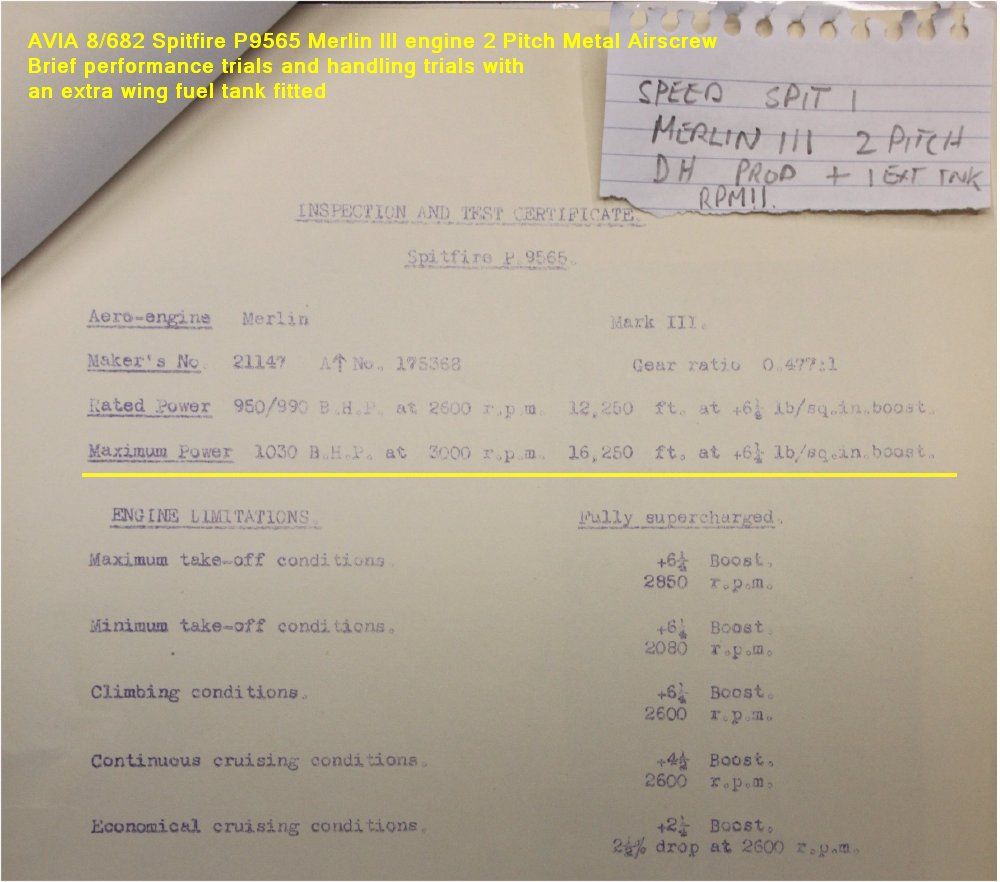 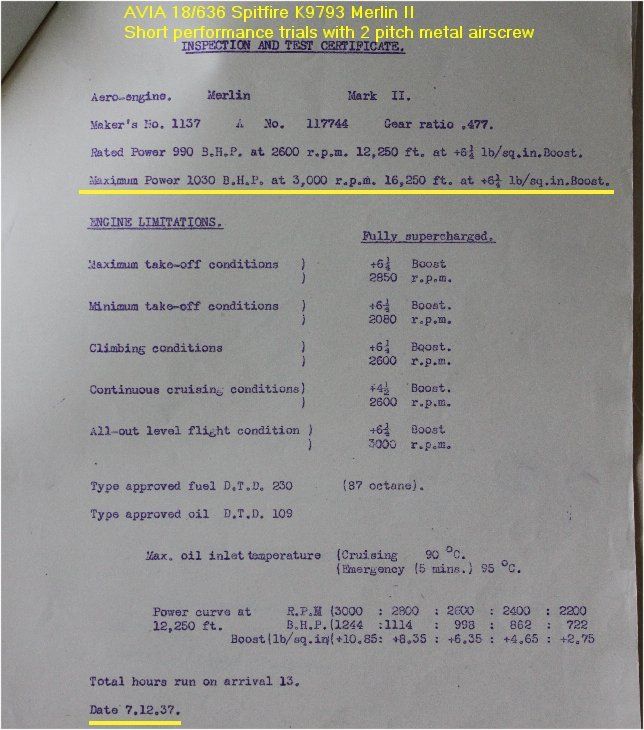 You are again trying to change history. You cover up your case by a smokescreen of Mathematical verbiage. RAE calculated that the Spitfire MKI had better sustained turn performance than the BF109E3. Pretty much every other report technical and general from either side of the conflict say the same. You on the other hand construct a graph that clearly shows the opposite. Find another single independent reference that proves the BF109E3/4 had better sustained turn performance than a Spitfire MKI. Whilst you are at it show us what this Mythical improved high altitude version that I supposedly referred to in another report and how this is supposedly used in the RAE turn chart Last edited by IvanK; 09-19-2012 at 03:27 AM.
|
 |
| Thread Tools | |
| Display Modes | |
|
|







 Linear Mode

