
|
|
|||||||
| FM/DM threads Everything about FM/DM in CoD |
 |
|
|
Thread Tools | Display Modes |
|
|
|
#1
 05-31-2012, 11:09 PM
|
|||
|
|||

the conclusion if you can really call it that is covered in the intro summary and the endpapers:
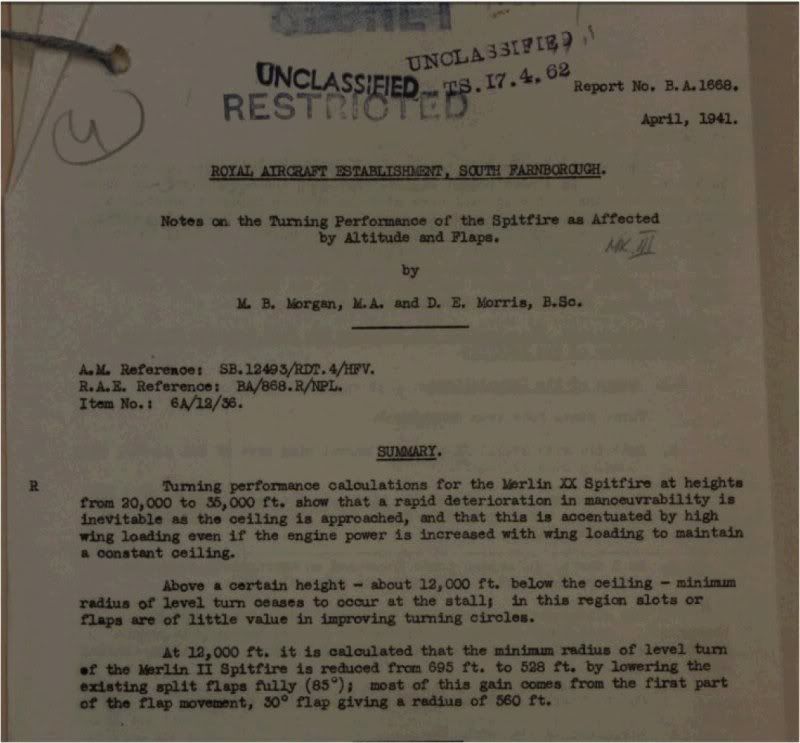 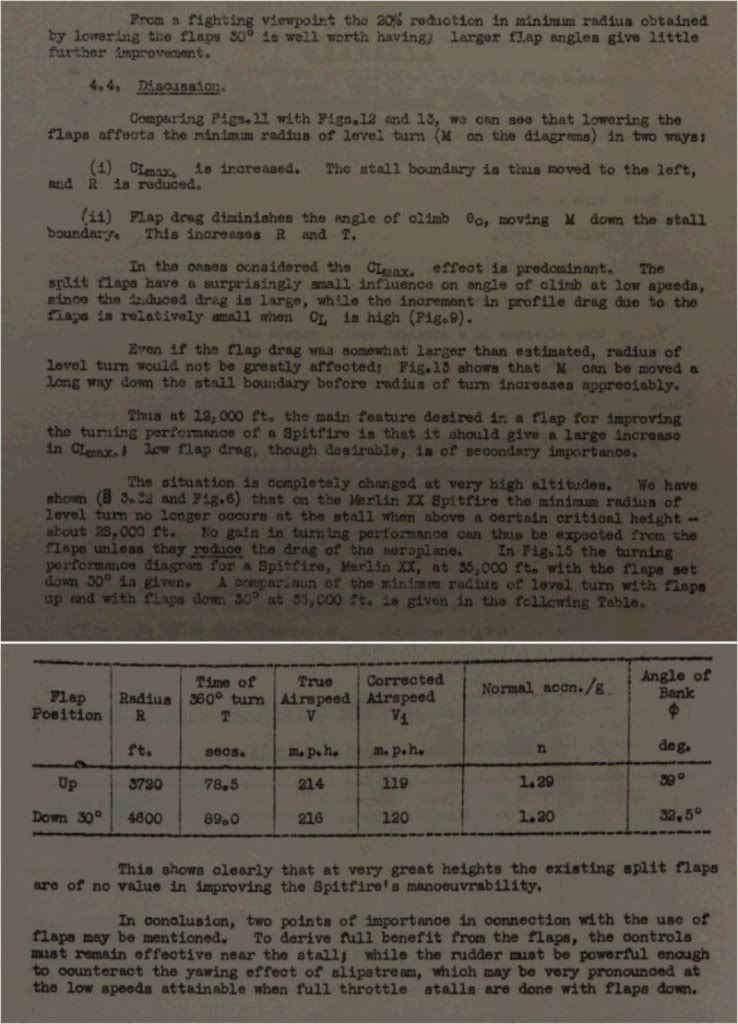 Crumpp I presume you are referring to these NACA documents: 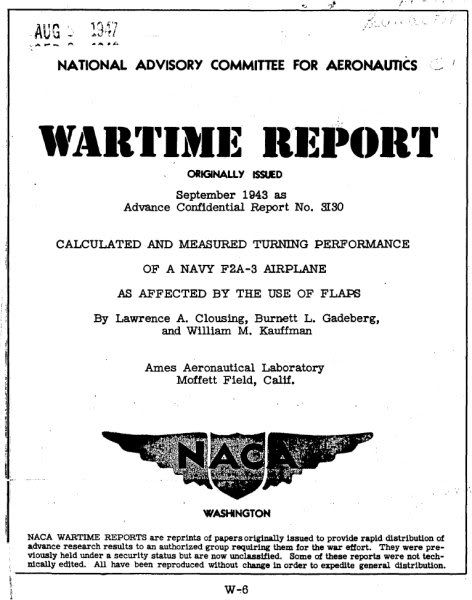 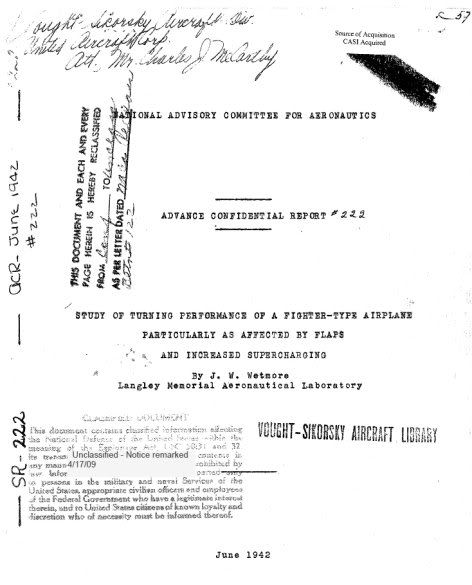 If so I have them. The RAE report is quoted as a source or reference in these NACA reports. In addition the first one also references the other RAE report "Notes on the dogfight" All three documents are imo in general agreement. The Devs should study these ! "Combat" flap usage in the classic IL2 imo was totally out of whack with reality ... sadly I am not so sure much has changed in CLOD. Last edited by IvanK; 06-01-2012 at 12:00 AM. 
|
|
#2
06-01-2012, 12:19 AM
|
||||
|
||||
|
Quote:
They are of very limited use in maneuvering to the average pilot. I think the NACA conclusion in ACR #222 sum it up the best. In general flaps can offer some turn performance improvements beyond the clean configuration stall point but not above it. In order to realize that improvement, a pilot must be able to precisely deploy the exact amount of flap required at the optimum speed to achieve that benefit. IIRC, the example they use is 130 mph and 127mph.... That small speed difference with the right amount of flaps realizes a turn performance increase but the same amount of flaps at just 3 mph slower speed results in worse turn performance.
|
|
#3
06-01-2012, 07:51 PM
|
|||
|
|||
|
Quote:
You have claimed R=900 ft turn radius and turn time T=21 s at 20,000 ft: Since I'm a metrics guy I will convert R to SI units, i.e. 274.3 m This gives a turn speed of 82.08 m/s (2*pi*R/T) So from this we calculate the turn acceleration: a=v**2/R=24.56 m/s**2 So load factor is n= sqrt(a**2+g**2)/g=2.696 Let's calculate the Cl this would require: n*m*g=0.5*ra*v**2*Cl*S Spitfire data: W=6000lb=2724 Kg S=242 sqft=22.36 m**2 ra=0.65 (Approx at 6.1 Km alt) Solving for Cl: CL=(2.696*2724*9.81)/(0.5*0.65*82.08**2*22.36)=1.47 Now NACA claims Clmax for the Spitfire at 1.2 which is a bit low but according to RAE it is 1.36 tops. Your claim leads to a Cl of 1.47 which is clearly unrealistic and like you fails the sanity check. BTW: I found a RAE report, R&M 2349, Notes on the turning performance of the Spitfire as affected by altitude and flaps. On page 4 there is a figure 4 which gives the following results for the Spitfire at 20,000 ft: R=1045 ft and T=31.5 s With my C++ simulations I get R=337 m (1106 ft) and T=31.65 s. You claim 21 s turn time and 900 ft radius of turn. I get 31.65 s and 1106 ft while Morgan & Morris in R&M get 1045 ft and 31.5 s. So on the one hand we have C++ simulation data and the data from the RAE report R&M 2349 which seems to tally and on the other hand we have your overbearing attitude and simplistic calculations leading to an off the chart Clmax. What could be the right number I wonder , 21 or 31 s? Finally, I think the only thing we actually agree on is the other parties lack of formal aerodynamic training. We have been down this road before and as I've told you before I have an Mcs in aeronautical engineering from the Royal Institute of Technology in Stockholm from 1986 and more than 10 years in the business working in the defense industry for Ericsson and SAAB on the Viggen and Gripen fighter systems. Tell me, What aeronautical companies have you worked with and the Msc in aeronautics from Embry-Riddle you claim to have, which year did you graduate and was that before or after your stint in US Special Forces? 
Last edited by Holtzauge; 06-06-2012 at 08:39 PM.
|
|
#4
06-01-2012, 10:33 PM
|
|||
|
|||
|
Math is good. Me likes math.

|
|
#5
06-01-2012, 10:52 PM
|
||||
|
||||
|
Quote:
__________________

|
|
#6
06-02-2012, 07:34 AM
|
|||
|
|||
|
Quote:
I don't like math.
__________________

|
|
#7
06-02-2012, 05:52 AM
|
|||
|
|||
|
Quote:
Now, think this for a minute instead insult the other members of the board. Last edited by MiG-3U; 06-02-2012 at 06:14 AM.
|
|
| Thread Tools | |
| Display Modes | |
|
|








 Hybrid Mode
