Fulqrum Publishing Home   |   Register   |   Today Posts   |   Members   |   UserCP   |   Calendar   |   Search   |   FAQ

Go Back   Official Fulqrum Publishing forum > Fulqrum Publishing > IL-2 Sturmovik: Cliffs of Dover > Technical threads > FM/DM threads

FM/DM threads Everything about FM/DM in CoD

Closed Thread
 
Thread Tools Display Modes
  #1  
Old 05-17-2012, 11:27 AM
NZtyphoon NZtyphoon is offline
Approved Member
 
Join Date: Feb 2012
Location: NZ
Posts: 543
Default

Having found a 1942 (?) copy of R A Beaumont Aeronautical Engineering: A Practical Guide for Everyone Connected with the Aero Industry (modern reprint http://www.pitstop.net.au/view/aviat...uery/plu/23199) it's interesting to read what he says about the "four degrees (types) of boost" used by British aero engines:

(1) Take-off Boost - ...an additional amount of induction-pipe pressure....accompanied by an extra richening of the mixture which prevents an unstable combustion termed detonation...(p. 105)

(2) The Rated Boost - often known as maximum climbing boost....boost pressure is reduced to a value which permits the engine to run continuously at that particular power output...(p. 105-106)

(3)Override Boost - For the greatest possible power output for take-off or emergency, an increase in pressure above the normal take-off boost is permitted on some engines. This condition is used in conjunction with a special fuel. (p. 106)

(4) Maximum Cruising Boost....

Thus it is specifically stated that override or emergency boost was used only in conjunction with a fuel that permitted the higher boost rating.
Attached Images
File Type: jpg Types of Boost 1.jpg (154.0 KB, 10 views)
File Type: jpg Types of Boost 2.jpg (184.4 KB, 8 views)

Last edited by NZtyphoon; 05-17-2012 at 11:36 AM.
  #2  
Old 05-17-2012, 02:08 PM
Ernst Ernst is offline
Approved Member
 
Join Date: Nov 2009
Posts: 285
Default

Acctualy the SIM should be: SUPERMARINE SPITFIRE: CLIFFS OF DOVER. I almost sure the right the devs must go to BoM. At least no spitfires there. Most of data here come only from two sources: spitfireperformance.com or from Kurfurst site. I am almost sure that the DEVS had other data, maybe from URSS evaluations of the SPITS and 109s that not exactly match the data presented here.

Last edited by Ernst; 05-17-2012 at 02:27 PM.
  #3  
Old 05-17-2012, 02:30 PM
Crumpp's Avatar
Crumpp Crumpp is offline
Approved Member
 
Join Date: Feb 2008
Posts: 1,552
Default

Quote:
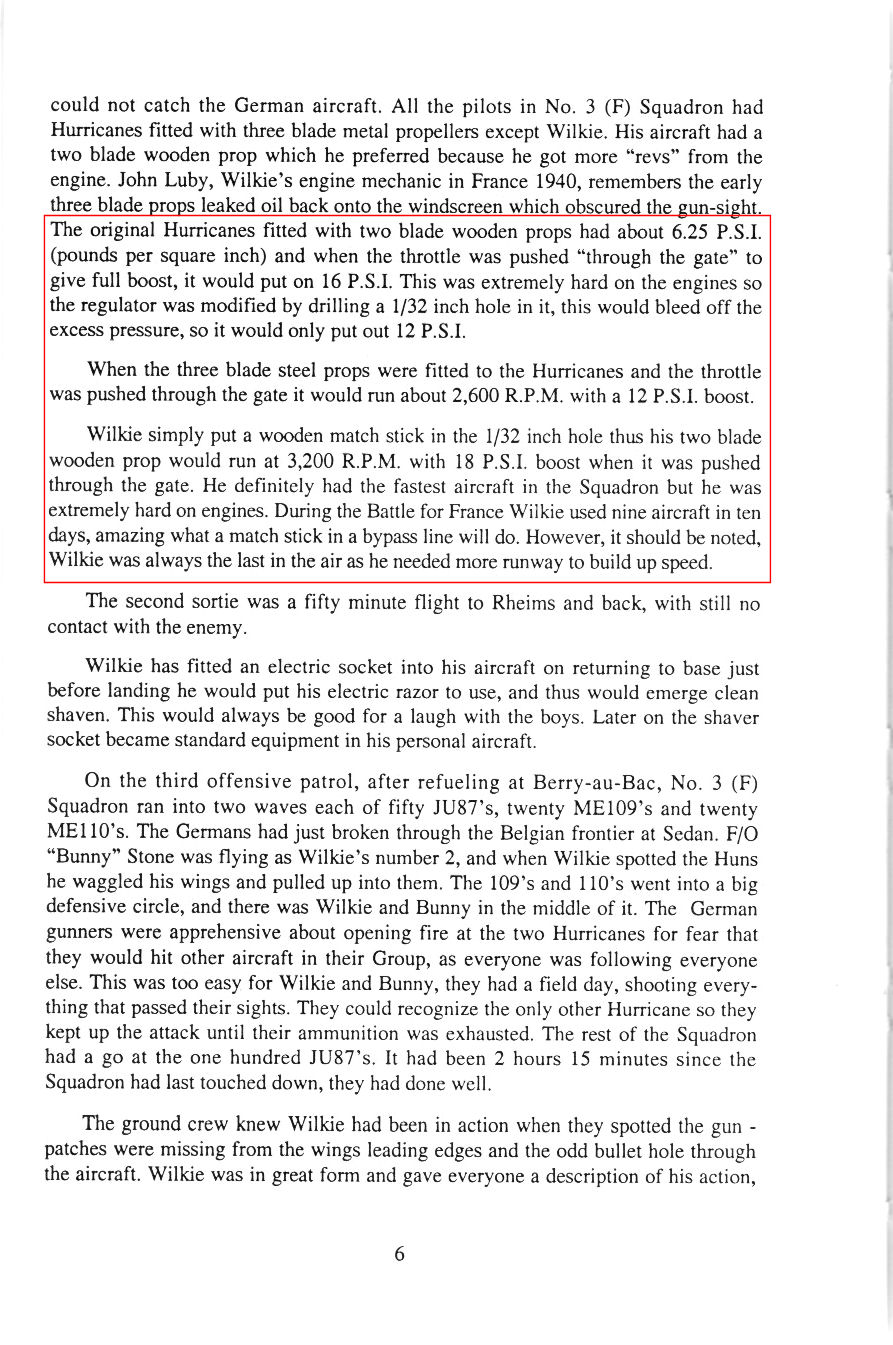
No, the engine couldn't run at 10.5lb boost with 87 octane fuel. The story about the pilot modding his engine with a match stick pertained to a Merlin III using 100 octane fuel and an unauthorised mod to obtain 16lb boost at low altitude Here's the some info on the use of 100 octane for development at RR:
No Seadog, it was possible as we can see from the Operating Notes. I am sure that engine was trashed after overboosting to +16lbs but it was definately possible on 87 Octane fuel.

It definately was not good but it was possible. Pulling the tit and overboosting the engine is not proof of the use of 100 Octane fuel.
  #4  
Old 05-17-2012, 06:15 PM
Seadog Seadog is offline
Approved Member
 
Join Date: Jun 2011
Posts: 226
Default

Quote:
Originally Posted by Crumpp View Post
No Seadog, it was possible as we can see from the Operating Notes. I am sure that engine was trashed after overboosting to +16lbs but it was definately possible on 87 Octane fuel.

It definately was not good but it was possible. Pulling the tit and overboosting the engine is not proof of the use of 100 Octane fuel.
read:


The above story clearly pertains to an engine that was already modded for 12lb boost (and thus using 100 octane) and the match stick mod permit boost up to 18lb, and it has already been established that Hurricanes in France were using 100 octane fuel by May 1940.

Maximum boost with 87 octane was 7lb:

http://www.spitfireperformance.com/spit2pnfs3.jpg

Last edited by Seadog; 05-17-2012 at 06:22 PM.
  #5  
Old 05-17-2012, 07:49 PM
NZtyphoon NZtyphoon is offline
Approved Member
 
Join Date: Feb 2012
Location: NZ
Posts: 543
Default

Quote:
Originally Posted by Crumpp View Post
Pulling the tit and overboosting the engine is not proof of the use of 100 Octane fuel.
Wrong - there are two engine tests, one on 87 Octane and one on 100 which both ran up to 10.5 lbs boost - there was no boost override used which, as Beaumont observed, required special fuel - ie: 100 Octane - to achieve. Later Merlin engines, such as the 45 series, were capable of boost override of +18 lbs but needed, and were designed to use, 100 Octane to do so. Later still +25 lbs boost could only be achieved using 150 Octane.
  #6  
Old 05-17-2012, 08:37 PM
Crumpp's Avatar
Crumpp Crumpp is offline
Approved Member
 
Join Date: Feb 2008
Posts: 1,552
Default

Quote:
It is clearly not allowed during combat situations.
Where does it clearly say that?

It does not, the General Operating Notes clearly say he can use it.

Last edited by Crumpp; 05-17-2012 at 08:39 PM.
  #7  
Old 05-17-2012, 08:53 PM
bongodriver's Avatar
bongodriver bongodriver is offline
Approved Member
 
Join Date: Mar 2011
Location: United Kingdom
Posts: 2,546
Default

Quote:
Originally Posted by Crumpp View Post
Where does it clearly say that?

It does not, the General Operating Notes clearly say he can use it.
Yes but only with 100 octane.

p.s. who did you quote?
__________________


Intel Q9550 @3.3ghz(OC), Asus rampage extreme MOBO, Nvidia GTX470 1.2Gb Vram, 8Gb DDR3 Ram, Win 7 64bit ultimate edition
  #8  
Old 05-17-2012, 09:01 PM
NZtyphoon NZtyphoon is offline
Approved Member
 
Join Date: Feb 2012
Location: NZ
Posts: 543
Default

Quote:
Originally Posted by Crumpp View Post
Where does it clearly say that?

It does not, the General Operating Notes clearly say he can use it.
Read the Merlin Operating notes again; "It is emphasised that high boost for emergency may only be employed with 100 Octane fuel..."

The Pilot's Notes General were to be be used in conjunction with the aircraft's Pilot's Notes, and with any limitations pasted into those notes using supplementary slips, and with the Merlin Engine operating notes: the Pilot's Notes General were never specific to any particular aircraft type.
  #9  
Old 05-18-2012, 06:21 AM
41Sqn_Banks 41Sqn_Banks is offline
Approved Member
 
Join Date: Oct 2007
Posts: 644
Default

Quote:
Originally Posted by Crumpp View Post
Where does it clearly say that?
"it is emphasized that the high boost for emergency may only be employed with 100 octane fuel"

Quote:
It does not, the General Operating Notes clearly say he can use it.
http://forum.1cpublishing.eu/attachm...8&d=1337207418

"Clearly say ..." we obviously have a different understanding what clearly means.

That's what I call clearly:
January 1939: http://forum.1cpublishing.eu/attachm...0&d=1334682385
"100 octane must be used"

March 1940: http://www.spitfireperformance.com/ap1590b.jpg
"100 octane must be used"

April 1940: http://www.wwiiaircraftperformance.o...erlin3-pg6.jpg
"100 octane ... must be used"

November 1940: http://forum.1cpublishing.eu/attachm...5&d=1337196053
"only be employed with 100 octane fuel"

June 1941: http://forum.1cpublishing.eu/attachm...0&d=1334727256
http://forum.1cpublishing.eu/attachm...1&d=1334727263
"only of 100 octane fuel is in the tanks"
  #10  
Old 05-18-2012, 12:48 PM
NZtyphoon NZtyphoon is offline
Approved Member
 
Join Date: Feb 2012
Location: NZ
Posts: 543
Default

Quote:
Originally Posted by Kurfürst View Post
Well let's see now the reality.

Tanker losses to all causes, I have gathered a total of 78(!!) tankers were sunk by mine, U-boot (typically), aircraft and raiders, between September 1939 and November 1940. About 90% of them were British, though there are a couple of Swedish, Dutch, French etc. tankers

I have them by name, date, cause of loss, route, cargo, tonnage and so on. For example indeed one tanker that went through Halifax, Inverdagle (9456 tons) was sunk by mines laid by the submarine U 34, with 12 500 tons of avgas - about a month worth consumption of 100 octane, though I am not sure what grade it actually carried - on the 16 January 1940....

Alltogether 558,260 GRT of tankers went to Davy Jones locker, by the end of November 1940, along with 385,957 tons of oil product. Half of that, ca. 243 000 GRT worth of tankers were sunk by the end May 1940.

Fuel oil was the greatest loss, 116 000 tons of it went down with tankers (luckily, no green peace back then). Avgas seems quite untypical as a load, but in the end it didn't really matter, because if a tanker sunk with diesel oil, or even empty, the next one had to haul about its cargo again.

Tanker losses were serious, unfortunately.
33rd Weekly Report Oil Position 23 April 1940 showing out of 242 Norwegian tankers 119 had been bought under Allied control, with 18 heading to Allied ports and the other 93 in neutral ports, or heading into neutral ports, the 119 brought under Allied control more than making up for the total tanker loss for the entire war period September 1939 to November 1940:


Quote:
Originally Posted by Kurfürst View Post
So disprove the statement of Pips. Since you misrepresent his position, I put it forward to you in its originality:

This is from a researcher, researching another subject (Dutch East Indies Fuel levels prior to the Japanese Invasion) at the Australian War Memorial Archives, from a document, copied to the Australian Military Commission in England in February 1941, by Roll Royce to Lord Beaverbrook outlining past, current and proposed changes to the Merlin; and factors that affect it's performance. It was a collection of lose-leaf typed pages, included as an addendum in a report titled Fuel Supplies to The British Empire And It's Commonwealth; Outlook, Ramifications and Projections For The Prosecution Of The War.

The reason why it is included amongst AWM papers is because the Australian Government at that time was protesting vigoriously about the continued supply of lower grade 87 octane fuel when it too wanted 100 octane for the RAAF. McFarland, Pugh, Hart, Perret, Lumsden and even Churchill have all quoted parts from the report.

The first bulk shipment of 100 octane fuel had arrived in Britain in June 1939 from the Esso refinery in Aruba. This and subsequent tanker shipments from Aruba, Curacao and the USA were stockpiled while the RAF continued to operate on 87 octane petrol. Having secured what were considered reasonably sufficient quantities of 100 octane, Fighter Command began converting its engines to this standard in March 1940, allowing boost (manifold) pressures to be raised without the risk of detonation in the cylinders. This initial increase in maximum boost from 6 lb to 9 lb delivered a useful power growth of around 130hp at the rated altitude.

By the time of the invasion of the Low Countries by Germany in May 1940 the RAF had converted approximately 25 % of it's total fighter force to 100 octane fuel use. The subsequent escalation in air activity and demands placed upon Fighter Command over the next two months put great strain on both the 100 octane fuel stockpiles and aircraft modified to use the fuel. Against the backdrop of total war the RAF found that it's reserves of 100 octane fuel was well below the level considered necessary for widespread use, for any sustained length of time.

Two actions were immediately undertaken by the British War Cabinet in May to resolve the looming crisis. Firstly 87 octane fuel was deemed the primary fuel source to be used until further supplies could be discovered and delivered in sufficient quantities to allow the Merlin conversions to again take place.
Those existing fighters already so converted (approximately 125) would continue to use what supplies of 100 octane were available, but all other fighters that had not been modified to continue with the use of 87 octane (of which there was more than adequate supply). The second action was for the British Government to contract the Shell Oil Refining Company to assist the British-controlled Iraqi Petroleum Company at Kirkuk to produce 100 octane fuel. This arrangement proved quite successful as production was quickly converted to 100 octane fuel.

The first Middle East shipment of 100 octane fuel arrived in Portsmouth on 12th August, with a further two deliveries in September and four in October. Although too late to allow widespread conversion for the use of the fuel the deliveries did ensure that from this point on Britain would not be lacking in 100 octane fuel levels. With the newfound supply RAF Fighter Command again embarked upon a Merlin II and III conversion to 100 octane use from late September, finally achieving 100% conversion of it's fighter force by the end of November in 1940.
"The subsequent escalation in air activity and demands placed upon Fighter Command over the next two months put great strain on both the 100 octane fuel stockpiles and aircraft modified to use the fuel"

1st Monthly Oil Position Report July 1940 ( Dated 6 August 1940)


Table from 1st Monthly Oil Report July 1940: Consumption: Read in conjunction with attachment 1:


Table from 1st Monthly Report July 1940; Stocks dropped by 15,000 tons April-May then increased by 12,000 tons to June:


Table from 33rd Weekly Oil Position Report 23 April 1940 showing 100 Octane fuel being stockpiled in the UK and overseas; "West of Suez" - France springs to mind.


Oil Position 5th Monthly Report November 1940:
Attached Images
File Type: jpg 100oct-consumption-bob.jpg (262.9 KB, 3 views)
File Type: jpg 100oct-stocks-39-40.jpg (218.1 KB, 3 views)

Last edited by NZtyphoon; 05-20-2012 at 02:32 PM.
Closed Thread

Thread Tools
Display Modes

Posting Rules
You may not post new threads
You may not post replies
You may not post attachments
You may not edit your posts

BB code is On
Smilies are On
[IMG] code is On
HTML code is Off

Forum Jump


All times are GMT. The time now is 12:37 PM.


Powered by vBulletin® Version 3.8.4
Copyright ©2000 - 2026, Jelsoft Enterprises Ltd.
Copyright © 2007 Fulqrum Publishing. All rights reserved.