
|
|
#181
 04-25-2012, 06:55 PM
|
|||
|
|||

Quote:
i was gonna write that is there a performance chart like the ones BS posted for the IIa? all this arguments and the spit IIa may become the "default" red fighter for a more even fight on most servers? 
|
|
#182
04-25-2012, 07:02 PM
|
||||
|
||||
|
until they pork that one too.
__________________
 Intel Q9550 @3.3ghz(OC), Asus rampage extreme MOBO, Nvidia GTX470 1.2Gb Vram, 8Gb DDR3 Ram, Win 7 64bit ultimate edition
|
|
#183
04-25-2012, 07:02 PM
|
|||||||
|
|||||||
|
Quote:
Hint: We know exactly in the case Quote:
Quote:
Quote:
As for the speeds for serial production planes, it can be read here. 500 km/h at SL. http://kurfurst.org/Performance_test...chreibung.html Suorce? I dont see any information about these. Quote:
As noted, G-6 tested at Rechlin shows the same. I suppose more accurate figures can be collected. Quote:
The rest is plainly in the files. Both V15 trial and the US trial show that they tested both in MS and FS gear. The Swiss is a bit of a guesswork, but then explain me: a) Why did the Swiss get a straight curve instead of a curved one, ie. a characteristic feature of the DB's barometric control, *when engaged* b) Why did the Swiss get a result exactly like the Germans in V15 trials while using the Hohenlader (FS gear). Quote:
Please translate the text below, then explain how it is different from the "serial production" E-1. Especially the Motorhaube noch roh, Rückstoßer oben unverkleidet part. An Bf 109 V 15 a, der Mustermachine für die E-1-Serie, wurden die Geschwindigkeitsleistungen erflogen. Aus Zeitmengel konnten nicht die günstigen Rückstoßer und Ansaughutzen erflogen werden, sodaß evtl. noch Leistungssteigerungen möglich sind. Zustand des Flugwerkes. Oberfläche : serienmäßiger Anstrich, Motorhaube noch roh, Rückstoßer oben unverkleidet. 2 Flügel- und 2 Hauben-MG eingebaut. Eindrahtantenne. Fahrwehr eingezogen, Sporn außen.
__________________
Il-2Bugtracker: Feature #200: Missing 100 octane subtypes of Bf 109E and Bf 110C http://www.il2bugtracker.com/issues/200 Il-2Bugtracker: Bug #415: Spitfire Mk I, Ia, and Mk II: Stability and Control http://www.il2bugtracker.com/issues/415 Kurfürst - Your resource site on Bf 109 performance! http://kurfurst.org 
|
|
#184
04-25-2012, 07:05 PM
|
|||
|
|||
|
Quote:
IIRC the DB601 manual also authorized the use only for overload conditions and short runways, not for regular take-off.
|
|
#185
04-25-2012, 07:06 PM
|
||||
|
||||
|
@Buchon,
Quote:
|
|
#186
04-25-2012, 07:09 PM
|
||||
|
||||
|
@Kurfurst, still waiting for your proof that all MKII's were limited to 9lbs from my post earlier,
Quote:
I've seen this obviously, dated july 1940 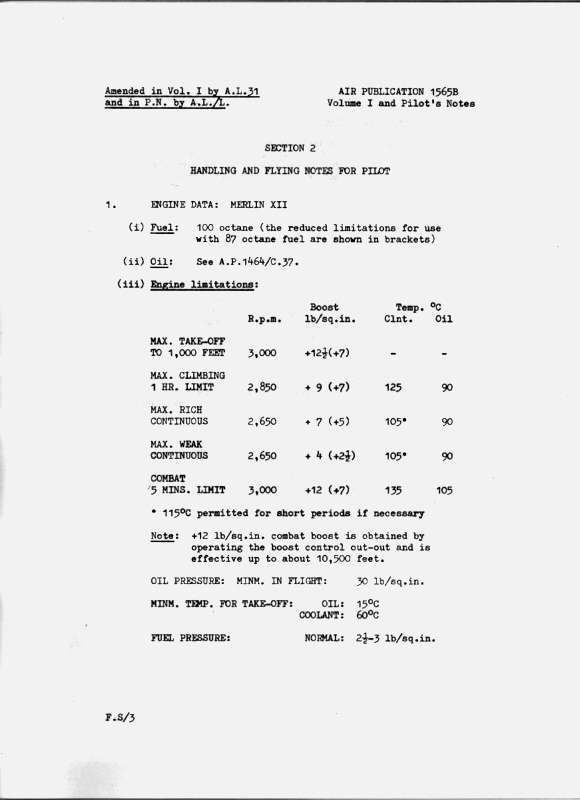 and as Crump has pointed out in the other thread that all Spit MkII's were using 100 octane fuel in June 1940. So what have you got that proves they were only on 9Lbs boost during BoB?
|
|
#187
04-25-2012, 07:13 PM
|
||||
|
||||
|
Quote:
My curve takes B6s data (orange line, which only went down to 3000m), projected down to 0 feet (yellow line). The projection may turn out to be not strictly accurate but is a fair basis for the question. If you look at Kwiatek's chart you will see along the line that starts at 283mph @ 0 feet the words +6 1/4 lbs boost, i.e. the max with 87 octane. The red line is when running 'Max Weak mix' which would of course yield less power and the boost pressure is not given but the pilots notes state that at the weakest setting the max permitted are +2 1/4lbs boost and 2.600 rpm. These are probably the settings reptresented by the red line.
__________________
klem 56 Squadron RAF "Firebirds" http://firebirds.2ndtaf.org.uk/  ASUS Sabertooth X58 /i7 950 @ 4GHz / 6Gb DDR3 1600 CAS8 / EVGA GTX570 GPU 1.28Gb superclocked / Crucial 128Gb SSD SATA III 6Gb/s, 355Mb-215Mb Read-Write / 850W PSU Windows 7 64 bit Home Premium / Samsung 22" 226BW @ 1680 x 1050 / TrackIR4 with TrackIR5 software / Saitek X52 Pro & Rudders
|
|
#188
04-25-2012, 07:15 PM
|
|||
|
|||
|
Quote:
Then add a new WEP line in the FM which is only useable for 1 min / ca 1.5 km and boost performance even further. Things would be perffect then, and very historical.   Quote:
__________________
Il-2Bugtracker: Feature #200: Missing 100 octane subtypes of Bf 109E and Bf 110C http://www.il2bugtracker.com/issues/200 Il-2Bugtracker: Bug #415: Spitfire Mk I, Ia, and Mk II: Stability and Control http://www.il2bugtracker.com/issues/415 Kurfürst - Your resource site on Bf 109 performance! http://kurfurst.org
|
|
#189
04-25-2012, 07:18 PM
|
|||
|
|||
|
Quote:
 I have to say this again? There no Boost performance modeled in the game, that´s why its in the Bugtraker, they are working to implement this. The graph that B6 posted contain no Boost :  That´s why the Patch line is below of the Flight Tests from 3000 to 6000, once the boost is implemented it will raise. We need the freaking Boost implemented correctly 
Last edited by Buchon; 04-25-2012 at 07:44 PM.
|
|
#190
04-25-2012, 07:18 PM
|
|||
|
|||
|
Quote:
The unamended (likely first or early) version from July 1940 shows the limit as +9 for 5 min Combat (+12 is enabled, but only for take off for a limited time/altitude).
__________________
Il-2Bugtracker: Feature #200: Missing 100 octane subtypes of Bf 109E and Bf 110C http://www.il2bugtracker.com/issues/200 Il-2Bugtracker: Bug #415: Spitfire Mk I, Ia, and Mk II: Stability and Control http://www.il2bugtracker.com/issues/415 Kurfürst - Your resource site on Bf 109 performance! http://kurfurst.org
Last edited by Kurfürst; 04-25-2012 at 07:23 PM. Reason: Found the damn paper from the manual, LOL
|
 |
| Thread Tools | |
| Display Modes | |
|
|








 Linear Mode

