Quote:
Originally Posted by TomcatViP

Regarding the HP of the Merlin as of NZT sources it : He is confusing SHP and BHP. It was a standard use in RR to give the power of an engine without the charger fitted as the methods used to calculate the true corresponding power at alt from a bench test ran on the ground were not reliable (source RR - already mentioned by myself somewhere in the thread).
|
How ever was the engine ever run to obtain the hp number as the supercharger was between the carb and the cylinders?
As Barbi and Eugene are so positive that 87 octane fuel was still in widespread use by RAF FC, they should have no trouble listing the squadrons, and the bases they flew from, that were still using 87 octane fuel late in the BoB.
As for Barbi's comment of fuel consumption, he is no doubt referring to the useless garbage graph (no source for the data points ever given) he posted earlier in this thread. Useless garbage because the consumption of 87 octane fuel includes that other RAF Commands (Coastal, Bomber, Training et al).
Quote:
|
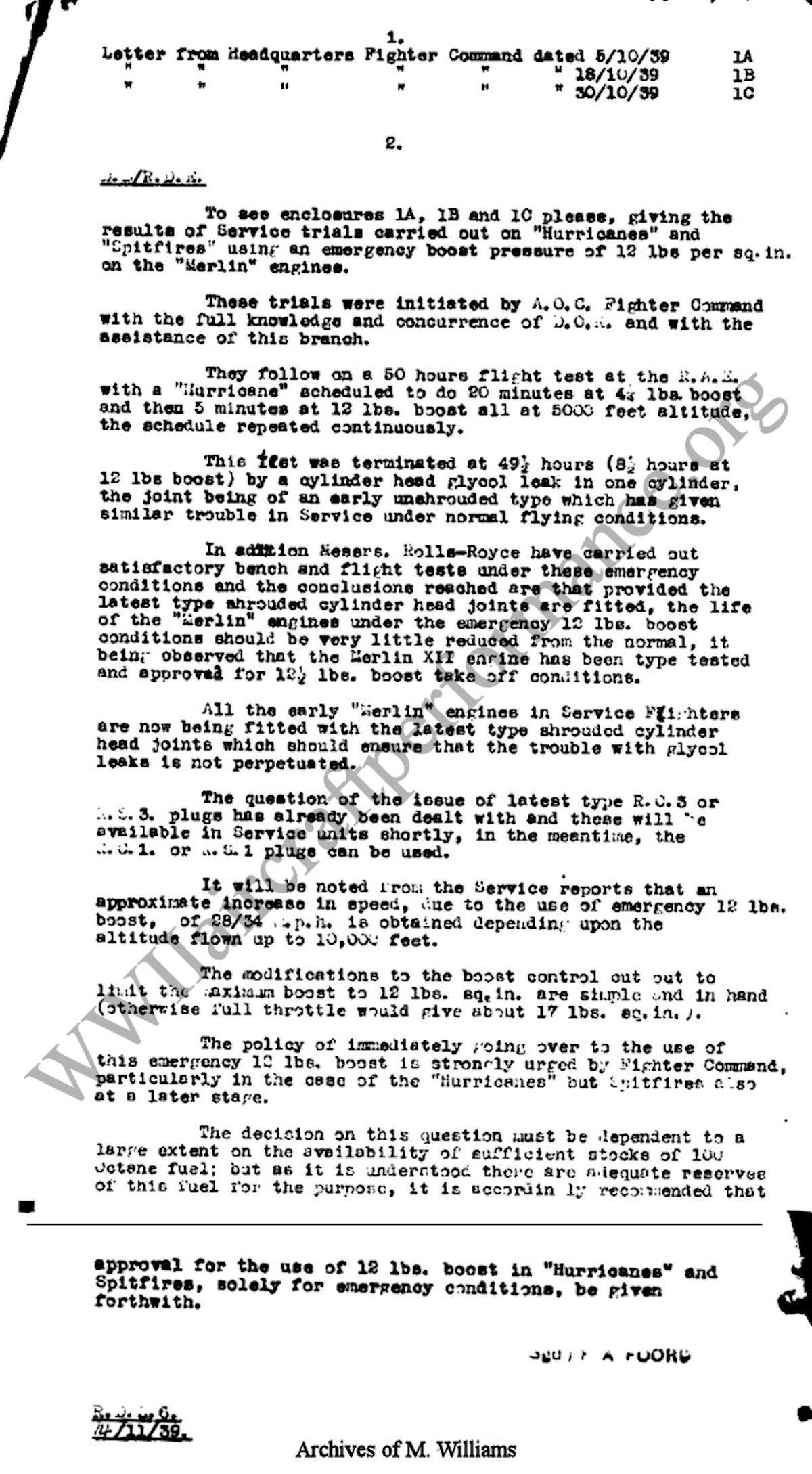
There's of course this paper of 7 August that supposed to 'authorize' all Commands for using 100 octane
|
Now this statement shows what a double standard Barbi has as he uses a German document, and [v]ONLY[/b] this document, giving authorization for 1.98ata use to 4 Gruppen with the Bf109K-4 and even goes on and speculates that other K-4 and G-10 units also used 1.98ata boost. This contradicts Eugene's emphatic statement that German units never ever did modifications without official authorization.
Quote:
|
It is not known if and how many units had converted to 1,98 ata manifold before that order came, but it should be noted these units, in particular III./JG 27, III./JG 53 and IV./JG 53 were the major users of the Bf 109 K-4 in the Lufwaffe. The other units effected are not known at present, but given the abundance of photograph depicting G-10 and K-4 fighters belonging to other units, marked for C-3 fuel use - a likely sign of the DC engine at 1,98 ata - the boost increase was likely not limited to JG 27 and JG 53 alone.
|


 03-14-2012, 02:33 PM






 Hybrid Mode
