
|
|
#331
 02-23-2012, 09:23 PM
|
||||||||
|
||||||||

Quote:
NB: Not all aircraft returned with empty tanks and RAF policy was to refill each aircraft as soon as possible after landing, or each evening or early morning, to avoid vapour traps. Blenheims were the only other aircraft known to have used 100 Octane fuel, albeit only in their outer wing fuel tanks, making things complicated for the poor pilots. (Warner, The Bristol Blenheim:A Complete History 2nd ed, page 100.) Merlin III & XIIs could still use 87 octane fuel, hence training flights and other secondary flight duties, such as delivery, ferry flights, etc could use 87 octane fuel instead of 100. Other aircraft known to have been using 100 Octane fuel were a small number of Beaufighters and PR Spitfires. Westland Whirlwinds still used, and continued to use 87 Octane right through their operational lives. Quote:
Quote:
Quote:
Quote:
 Quote:
The HX convoys incorporated cargo ships, some of which carried aviation fuel, and tankers: many of the latter had sailed from refineries in the West Indies and America. The BHX series sailed from Bermuda, starting in May 1940 (BHX.41), and joined the main HX convoys in Halifax. Some of the tankers from the HX convoys diverted to French ports, enough to supply the RAF fighters in France. From the HX series of convoys alone (HX 11, 13, 31, 33-35, 40, 43, 49, 55, 57-59, 64-68, 70, 73, 76) 44 tankers carrying AVGAS arrived in British or French ports; one tanker was destroyed by a mine in the Bristol channel. This contradicts the assertion in Shacklady and Morgan that ...large numbers of tankers were sunk by German submarines... Another reputable secondary source is "Oil" by Payton-Smith which, as noted, is the official war history. He notes that "...in the summer of 1940 there was a surplus of these ships (tankers) because of the incorporation into the British merchant marine of tanker fleets from countries over-run by Germany." pp. 128–130. Quote:
In "Oil" (Official Second WW history) Payton-Smith said: "By 1939...The prospects of securing sufficient supplies of 100-octane fuel in addition to the 87-octane petrol required for non-operational flying looked doubtful...(he goes on to state on page 57)...It was true that by 1939 it seemed increasingly unlikely that American supplies would be withheld. But to have accepted anything less than absolute certainty, to have depended on the goodwill of foreign suppliers to meet the essential needs of the Royal Air Force, would have been a radical break with traditions that had governed British oil policy since long before the First World War." Meaning that the pre-war planning papers quoted by KF were being conservative in their estimates, as per a long held tradition. Payton-Smith went on to say: "...this problem (supply of 100 Octane aviation fuel) disappeared; production of the new fuel in the US, and in other parts of the world, increased more quickly than expected with the adoption of new refining techniques." pp. 259-260 Interesting how KF resorts to pre-war planning documents to say what happened up to 16 months later, during the Battle of Britain, yet cannot provide primary documentation to prove that the situations discussed up to two years earlier actually eventuated in 1940. And his assertions about "doctored" documents when his own documentation is so shoddy and questionable? Quote:
Interesting to note that Merlin engines using 100 Octane fuel were being built in 1938, as well as C.P propellers http://www.flightglobal.com/pdfarchi...0-%203453.html Last edited by NZtyphoon; 02-23-2012 at 09:29 PM. Reason: Minor grammatical changes |
|
#333
02-23-2012, 10:20 PM
|
|||
|
|||
|
Just for fun whilst on the subject - from Flight, March 28, 1940
 From IWM: 19 Squadron, Fowlmere, Sept. 1940 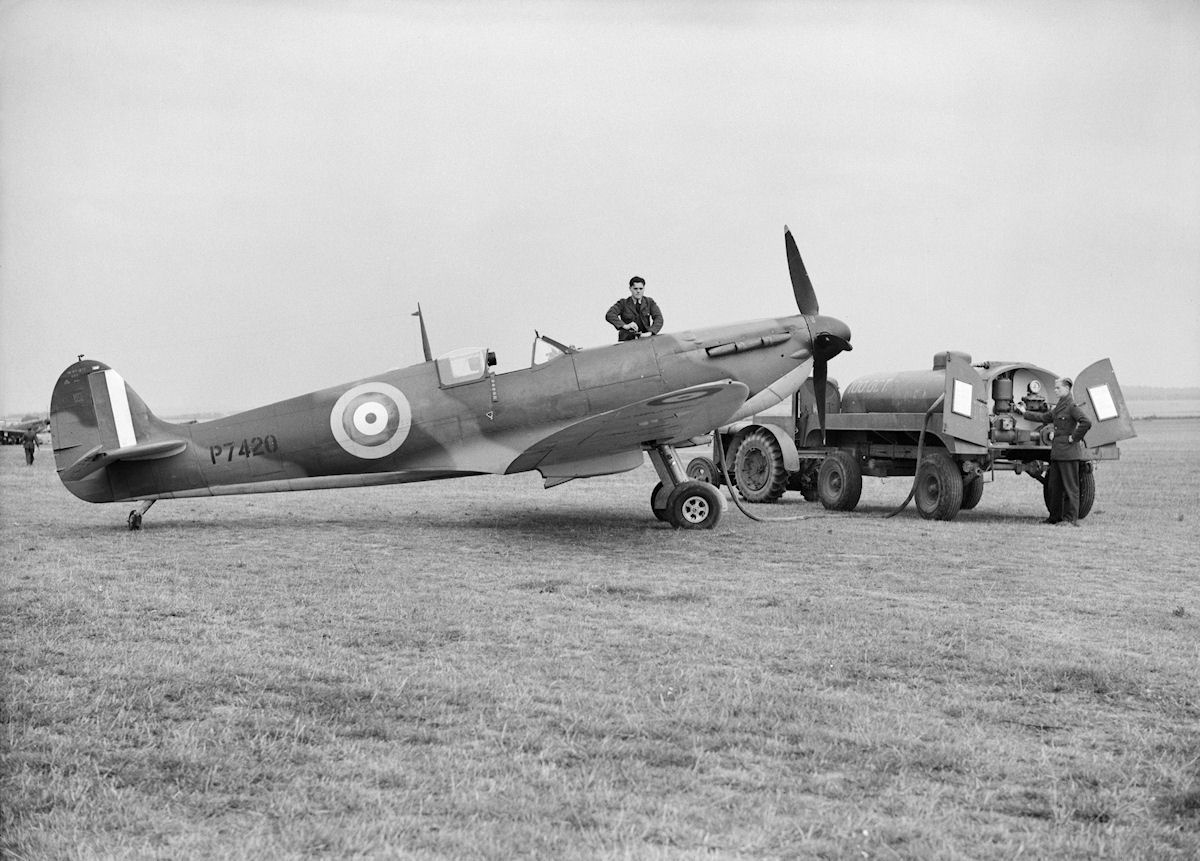 
|
|
#334
02-23-2012, 10:56 PM
|
|||
|
|||
|
Quote:
The photo is of a 137 Sqn "Whirlybomber" from at least mid-to late 1942, so is it possible that the R-R Peregrine was rated to use 100 Octane by then? |
|
#335
02-23-2012, 11:08 PM
|
|||
|
|||
|
From another forum:
Reserves Information The following information are the reserve stocks of 100 Octane fuel during the BOB period This information has come from the War Cabinet Oil Position Monthly report (a) that is available from the National Archives, as well as Gavin Baileys paper(b) and Wood and Dempster(c). Stocks of 100 Octane 30th September 1939 153,000 tons(b) 27th February 1940 220,000 tons(b) 31st May 1940 294,000 tons(a) 11th July 1940 343,000 tons(b) 31st August 1940 404,000 tons(a) 10th October 1940 424,000 tons(c) 30th November 1940 440,000 tons(a) Oh found this: from http://www.flightglobal.com/pdfarchi...0-%202155.html "It fell to the Shell Development Company in California to produce for the first time a commercially manufactured 100-octane gasoline in 1935. It was 50/50 straight-run material with synthetic blending agents, plus 4.8 c.c. tetra-ethyl-lead per Imperial gallon." Last edited by NZtyphoon; 02-23-2012 at 11:49 PM. |
|
#336
02-24-2012, 12:23 AM
|
|||
|
|||
|
Quote:
 I have Warner's Blenheim book and in reviewing the bit about 100 octane in the outer wing tanks he wrote: "To take full advantage of 100 octane petrol the supercharger pressure could be increased from the normal 'Plus 5 lb/sq.in. boost' by the operation of an 'Emergency Boost Override' lever on the instrument panel. This overrode the Automatic Boost Control to allow 'Plus 9 lb' pressure, and was used for take-off and in emergencies only, for a maximum of 5 minutes." Interesting - and not unlike the Hurricane and Spitfire use of the boost cut-out enabling +12 lbs, although rather more complicated in practice apparently. |
|
#337
02-24-2012, 02:43 AM
|
||||
|
||||
|
19 Squadron, Fowlmere, Sept. 1940
Nuff said imho
__________________
Theres a reason for instrumenting a plane for test..
That being a pilots's 'perception' of what is going on can be very different from what is 'actually' going on. |
|
#338
02-24-2012, 02:46 AM
|
|||
|
|||
|
I did some research on this when i was active on my pet project, "getting off the ground in a Blenheim in CoD"
 After reading through a copy of the pilot's operating handbook i found online, that's what i could gather: 1) Extra tanks were installed in the wings for more range. 2) This made the aircraft too heavy to safely take-off with bombs loaded. 3) Higher boost was needed. 4) Only the outer tanks got 100 octane fuel to assist in take-off, enabling use of +9 psi boost. This can be easily gleaned from reading the checklists. It was not as much of a WEP setting, as it was simply a "take off when overloaded" power setting. There were also other kinds of weirdness involved because only one pair of tanks had the ability to jettison fuel, the default inner tanks. This meant that the potential for WEP was completely wasted: crews were instructed to cruise to the target on the outer 100-octance tanks and drain them completely before switching to the inner ones, since the outer ones couldn't be drained by jettisoning fuel in an emergency. As such, the 100 octane fuel was effectively used during the probably safest part of the journey at cruise settings (or at least when some element of surprise still existed, during the inbound leg), not during the return from the target for escaping flak and fighters when it would mostly be needed. Historical loadouts for short range missions were what we use when we fly it in multiplayer on the CoD map: just 55%-60% of fuel (that is the threshold between inner and outer tanks), with the engines limited at +5 psi boost. |
|
#339
02-24-2012, 05:01 AM
|
|||
|
|||
|
Quote:
P7420 IIa CBAF MXII 6MU 16-9-40 19S 26-9-40 flew into tree nr Boxford Sussex Sgt Roden killed 15-11-40 SOC 23-11-40 FH44.40 |
|
#340
02-24-2012, 06:22 AM
|
|||
|
|||
|
Quote:
The photo is part of a whole sequence of 137 Sqn photos taken at Manston in 1943; the last Whirlwind ops for 137 occurred on 21 June 1943, when 137 stood down to re-equip with Typhoons.The remaining Whirlwinds were transferred to 263 Sqn which had its last op in December before re-equipping with Typhoons. |
 |
| Thread Tools | |
| Display Modes | |
|
|


 Linear Mode

