Fulqrum Publishing Home   |   Register   |   Today Posts   |   Members   |   UserCP   |   Calendar   |   Search   |   FAQ

Go Back   Official Fulqrum Publishing forum > Fulqrum Publishing > IL-2 Sturmovik: Cliffs of Dover > Technical threads > FM/DM threads

FM/DM threads Everything about FM/DM in CoD

Reply
 
Thread Tools Display Modes
  #1  
Old 01-22-2012, 10:15 AM
camber camber is offline
Approved Member
 
Join Date: Oct 2011
Posts: 105
Default

Gentlemen!

So many of these arguments seem to based on interpreting an slightly ambiguous statement to make it wrong.

Quote:
Originally Posted by JtD View Post
As an example of WW2 climb tests, look at table I in this Spitfire IX test, you can see a constant IAS up to FTH and a constant TAS above FTH. Il-2 compare will always give you constant TAS, which will give you the somewhat higher climb performance below FTH, about 100 fpm in this case. Less than 5% obviously, and all I wanted to say.
Well this is pretty clear and supported by the reference. the Spittie pilots doing that test climbed at constant IAS mostly and recorded climb rate.

Quote:
Originally Posted by Crumpp View Post
Climb speed will never be constant with altitude. Any pilot or first year aeronautical science students knows this....
Obviously the pilot can choose to climb at constant IAS if aircraft capability permits. I take it, this statement should be:

Vx (IAS for best climb angle) and Vy (IAS for best rate of climb) will never be constant with altitude."

This is true enough but I know a flight instructor that had it a bit confused . So climb tests at constant IAS (such as that Spittie one) may not be capturing optimum rate of climb at each altitude? Interesting.

Quote:
Originally Posted by JtD View Post
Yes, and in second year they learn that there always are exceptions to the rule, and thus it's "hardly ever" and not "never". An example for an exception has already been given in this topic, so feel free to educate yourself.
There seems no real disagreement at this point, just an imaginary one

Quote:
Originally Posted by Crumpp View Post
Baloney. To achieve Vx or Vy, velocity must change with altitude. There are no exceptions to that no matter how much you tap dance.
A clearer statement now it is expanded from just "climb speed".

It is quite hard to write unambiguously in technical detail, and anyone's forum posts are likely to fall down on this now and again regardless of their aviation knowledge. But instead of jumping on it as evidence of moron, why not have a lovely big glass of wine? Of course that is what I am doing AND writing this post, so maybe you can do both if you really want to

2007 Reisling, camber
Reply With Quote
  #2  
Old 01-22-2012, 03:49 PM
JtD JtD is offline
Il-2 enthusiast & Moderator
 
Join Date: Oct 2007
Posts: 903
Default

Oh, an educated voice of reason with good manners, what a refreshing sight. I sure hope to see you around for a long time!
Reply With Quote
  #3  
Old 01-22-2012, 05:26 PM
ACE-OF-ACES's Avatar
ACE-OF-ACES ACE-OF-ACES is offline
Approved Member
 
Join Date: May 2010
Location: NM
Posts: 2,248
Default

Quote:
Originally Posted by camber View Post
Quote:
Originally Posted by Crumpp View Post
Climb speed will never be constant with altitude. Any pilot or first year aeronautical science students knows this....
Obviously the pilot can choose to climb at constant IAS if aircraft capability permits.
The funny part is Crumpp is saying the same thing

He just appears to be a little confused with regards to 'vector math' (what he called correct physics).

That being the resultant (single) vector that is the equivalent of a set (more than one) of vectors. Where is is possible to have a resultant vector with constant magnitude as it changes direction.

In this case the 'resultant' vector is IAS, that is the equivalent of the Vx and Vy set of vectors

From the spitfire test data we can see it maintained a constant IAS for most of the climb, but at the same time the ROC changed as the spitfire climbed.

Mathematically speaking, the resultant vector (IAS) 'direction' changed to maintain the resultant vector (IAS) 'constant magnitude'.

In the case of the spitfire ROC test the 'climb angle' changes which in turn changes the direction of the resultant vector (IAS). Which in turn changes the magnitude of Vy and Vx.

Note in this case Vy is equal to the ROC, the vertical component and Vx is equal to the horizontal component (i.e. earth frame of reference aka coordinate system)

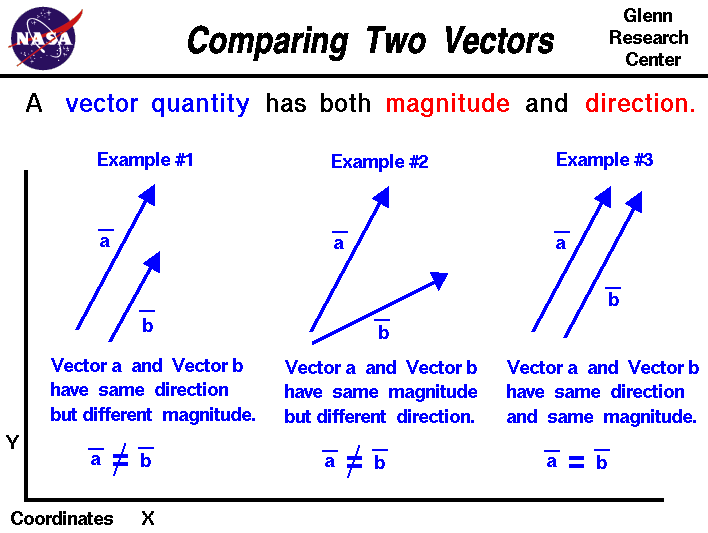
At this point I think it would help those having trouble with vector math to check out the following link..

Comparing Two Vectors

Paying special attention to Example #2, vectors with same magnitude but different directions, i.e.


And just to be crystal, allow me to say this again, the 'constant' climb speed statement was more of a test pilot term.. It did not mean they kept it constant down to three decimal places, that is just humanly impossible. What it meant was 'when' you change the IAS during the climb as required, the change should be made as smoothly as possible such that the change in acceleration was kept as small as possible.
__________________
Theres a reason for instrumenting a plane for test..
That being a pilots's 'perception' of what is going on can be very different from what is 'actually' going on.

Last edited by ACE-OF-ACES; 01-22-2012 at 11:33 PM.
Reply With Quote
  #4  
Old 01-22-2012, 06:20 PM
41Sqn_Banks 41Sqn_Banks is offline
Approved Member
 
Join Date: Oct 2007
Posts: 644
Default

Quote:
Originally Posted by camber View Post
Well this is pretty clear and supported by the reference. the Spittie pilots doing that test climbed at constant IAS mostly and recorded climb rate.

Obviously the pilot can choose to climb at constant IAS if aircraft capability permits. I take it, this statement should be:

Vx (IAS for best climb angle) and Vy (IAS for best rate of climb) will never be constant with altitude."

This is true enough but I know a flight instructor that had it a bit confused . So climb tests at constant IAS (such as that Spittie one) may not be capturing optimum rate of climb at each altitude? Interesting.
Spitfire I Pilot's Notes state:

Quote:
CLIMBING

9. For maximum rate of climb the following speeds are recommended: -

Ground level to 12,000 feet 185 m.p.h. A.S.I.R.

12,000 feet to 15,000 feet 180 " "

15,000 " 20,000 " 170 " "

20,000 " 15,000 " 160 " "
Hurricane I Pilot's Notes state:

Quote:
Optimum climbing speeds (A.S.I. reading)

For aeroplanes fitted with 2-bladed wood airscrews to Drg. No. Z. 3895 and with kidney type exhaust manifolds, the optimum full throttle indicated climbing speed at sea level and up to 10,000 ft. is constant at 157 m.p.h., A.S.I. reading with a reduction of 1 m.p.h. for each additional 1,000 ft. of altitude.

Note. - The all-up weidght of the aeroplane during the tests upon which the above climbing speeds are based was 6,000 lb.
Reply With Quote
  #5  
Old 01-23-2012, 12:58 AM
Crumpp's Avatar
Crumpp Crumpp is offline
Approved Member
 
Join Date: Feb 2008
Posts: 1,552
Default

Quote:
Obviously the pilot can choose to climb at constant IAS if aircraft capability permits
Climb speed refers specifically to Vx or Vy. It is not common to split hairs on it having it mean anything but Vx or Vy without specifying the condition of flight.

http://www.experimentalaircraft.info...imb-speeds.php

All aircraft can climb at a constant IAS. If you do that however, you are not at Vx or Vy.
Reply With Quote
  #6  
Old 01-23-2012, 01:04 AM
Crumpp's Avatar
Crumpp Crumpp is offline
Approved Member
 
Join Date: Feb 2008
Posts: 1,552
Default

There is no reason for a huge involved, "Gee Whiz, I wish I was smart" discussion on this topic.

It is a simple fact, an airplanes climb speeds or Vx and Vy, are not constant with altitude. No amount of tap dancing or splitting hairs will change the physics.

In practical terms for flying an airplane it is easier to remember a few speeds for Vx and Vy that get you in the ballpark or just hold it constant so you only have to remember 2 numbers.
Reply With Quote
  #7  
Old 01-23-2012, 01:13 AM
Crumpp's Avatar
Crumpp Crumpp is offline
Approved Member
 
Join Date: Feb 2008
Posts: 1,552
Default

Quote:
Hurricane I Pilot's Notes state:
Read your Hurricanes notes....

Quote:
Optimum climbing speeds (A.S.I. reading)
Optimum for what???? Is that best rate or best angle???

It is actually because of the fixed pitch propeller but lets not get ahead of ourselves and get all confused on the correct principles for climbing speeds.
Reply With Quote
  #8  
Old 01-23-2012, 03:29 AM
ACE-OF-ACES's Avatar
ACE-OF-ACES ACE-OF-ACES is offline
Approved Member
 
Join Date: May 2010
Location: NM
Posts: 2,248
Default

Quote:
Originally Posted by camber View Post
Obviously the pilot can choose to climb at constant IAS if aircraft capability permits. I take it, this statement should be:

Vx (IAS for best climb angle) and Vy (IAS for best rate of climb) will never be constant with altitude."

This is true enough but I know a flight instructor that had it a bit confused .
Well flight instructors are only human!

But re-reading your reply I noticed something..

But first some definitions

In pilot jargon terms (read not math terms)

Vx best angle of climb 'airspeed'
Vy best rate of climb 'airspeed'

Put another way

Vx is the 'airspeed' that produces the most altitude in the shortest ground distance
Vy is the 'airspeed' that produces the most altitude in the shortest amount of time

For example

Vx is the airspeed you would want to climb at if your goal is to clear an obstacle at the end of the runway
Vy is the airspeed you would want to climb at if your goal was to intercept the bombers

The point to notice here is both Vx and Vy are 'airspeeds', be it indicated (IAS) or true (TAS).

Which should not be confused with the Vx and Vy I used in my previous (mathematical) example on the resultant vector! Where the Vx and Vy velocity tied to the x and y axis frame of reference. These pilot jargon terms Vx and Vy are actually the resultant vector, i.e. airspeed.

Quote:
Originally Posted by camber View Post
So climb tests at constant IAS (such as that Spittie one) may not be capturing optimum rate of climb at each altitude? Interesting.
Not likely..

They were more than capable of determining the airspeed that produced the best ROC. With regards to WWII they would do several test and different airspeeds to determine which one produces the best ROC.

One thing to take note of, with regards to WWII test data, most WWII fighter aircraft didn't have TAS gauges, which explains why most WWII ROC data gives airspeeds in IAS, and most if not all of those WWII test reports that do provide TAS, TAS was calculated (post test processing) from IAS.

So most WWII references are in terms of IAS. Where as today TAS gauges are more prevalent, and therefore most modern pilot discussions on Vx and Vy are talking in terms of TAS, where most make note of how Vx (TAS) and Vy (TAS) airspeed changes with altitude.

We also know that TAS changes with altitude relative to IAS, So even with a constant IAS, TAS is changing.

In WWII they typically referred to the airspeed that produced the best ROC as the 'best climb speed', which in todays pilot jargon equates to Vy (best rate of climb airspeed).

Therefore with regards to the WWII ROC test reports jargon vs modern pilot jargon, the constant indicated airspeed (IAS) in the WWII ROC test is the same as saying Vy indicated today, convert both to TAS and this WWII story will match those of today, where Vy changes with altitude.
__________________
Theres a reason for instrumenting a plane for test..
That being a pilots's 'perception' of what is going on can be very different from what is 'actually' going on.

Last edited by ACE-OF-ACES; 01-23-2012 at 03:40 AM.
Reply With Quote
  #9  
Old 01-23-2012, 07:39 AM
41Sqn_Banks 41Sqn_Banks is offline
Approved Member
 
Join Date: Oct 2007
Posts: 644
Default

Quote:
Originally Posted by ACE-OF-ACES View Post
Not likely..

They were more than capable of determining the airspeed that produced the best ROC. With regards to WWII they would do several test and different airspeeds to determine which one produces the best ROC.

One thing to take note of, with regards to WWII test data, most WWII fighter aircraft didn't have TAS gauges, which explains why most WWII ROC data gives airspeeds in IAS, and most if not all of those WWII test reports that do provide TAS, TAS was calculated (post test processing) from IAS.

So most WWII references are in terms of IAS. Where as today TAS gauges are more prevalent, and therefore most modern pilot discussions on Vx and Vy are talking in terms of TAS, where most make note of how Vx (TAS) and Vy (TAS) airspeed changes with altitude.

We also know that TAS changes with altitude relative to IAS, So even with a constant IAS, TAS is changing.

In WWII they typically referred to the airspeed that produced the best ROC as the 'best climb speed', which in todays pilot jargon equates to Vy (best rate of climb airspeed).

Therefore with regards to the WWII ROC test reports jargon vs modern pilot jargon, the constant indicated airspeed (IAS) in the WWII ROC test is the same as saying Vy indicated today, convert both to TAS and this WWII story will match those of today, where Vy changes with altitude.
+1
Reply With Quote
  #10  
Old 01-23-2012, 07:53 AM
41Sqn_Banks 41Sqn_Banks is offline
Approved Member
 
Join Date: Oct 2007
Posts: 644
Default

Quote:
Originally Posted by Crumpp View Post
Read your Hurricanes notes....
I did, it still says constant IAS to FTH and linear reduction above optimum climb.

Quote:
Optimum for what???? Is that best rate or best angle???
Best rate of climb.

Quote:
It is actually because of the fixed pitch propeller but lets not get ahead of ourselves and get all confused on the correct principles for climbing speeds.
This is not propeller related. There are performance tests with Rotol propellers show that the same applies to Hurricanes or Spitfires with CSP.
Reply With Quote
Reply

Thread Tools
Display Modes

Posting Rules
You may not post new threads
You may not post replies
You may not post attachments
You may not edit your posts

BB code is On
Smilies are On
[IMG] code is On
HTML code is Off

Forum Jump


All times are GMT. The time now is 11:45 AM.


Powered by vBulletin® Version 3.8.4
Copyright ©2000 - 2026, Jelsoft Enterprises Ltd.
Copyright © 2007 Fulqrum Publishing. All rights reserved.