
|
|
#82
 10-27-2011, 01:41 AM
|
||||
|
||||

Quote:
http://kurfurst.org/Performance_test...formanceT.html 
|
|
#83
10-27-2011, 04:57 AM
|
|||
|
|||
|
Unless the French installed there own manifold boost pressure instrument in the 109, the boost pressure used would be conversions of the German manifold boost instrument installed in all 109s, ie ata to mmHg.
|
|
#84
10-27-2011, 11:03 AM
|
||||
|
||||
|
Quote:
They certainly could have used their own measurements. We don't know enough to determine it and any other conclusion is just a guess. Last edited by Crumpp; 10-27-2011 at 11:07 AM. Reason: added link to report
|
|
#85
10-27-2011, 05:15 PM
|
|||
|
|||
|
Well, we might not know but we can take the most probable assumption. The chances that they would be wrong would be accordingly small.
Unless some specific clues indicating that the French were using a different transversion from ata to mmHg exist the most probable assumption would be that they used the same.
|
|
#86
10-27-2011, 08:52 PM
|
||||
|
||||
|
Quote:
What instruments did they use? They only had a 3% instrument error which is very good. Most bourdon tube or bellows instruments found in the panel are ~5%. What is a fact is that the data is not converted to standard conditions.
|
|
#87
10-28-2011, 12:43 AM
|
||||
|
||||
|
Do we know if the E-4 modelled in game has got (or is supposed to have) a DB 601 Aa engine?
The 'French test' is very interesting, but as Crumpp says, somewhat difficult to use for modelling a E-3 for the sim. The instruments are not the biggest problem really - we can still convert it back, we can also convert the whole test to 'standard day'. The issue seems to be the shape of the plane and components replaced / used, oil, glycol etc... The French apparently had a German manual to compare the outcomes with, and although the top speed was matching, there were some problems with overheating and even engine malfunction (not specified though) resulting poor climb rates when compared to the manual. It took them almost 2 minutes longer to climb to 6000m, that's a massive difference. The 50km/h difference Kwiatek pointed out might also have something to do with the overheating problems - rads were really draggy, but the 50km/h difference between fully open and fully close is rather surprising. Mind you that the difference with and without 500kg bomb was exactly the same at comparable power for a E-4/B (E-3/B), see here Regarding the differnce between 'guaranteed' and real perofmance:  I know that's the V15a, but you get the idea why I think it would be generally unwise to modell the E-4 for CLoD after manufacturer's promises.
|
|
#88
10-28-2011, 03:25 AM
|
||||
|
||||
|
It's not a promise it's a contract. I.e. if the aircraft doesn't meet the specifications laid out in the contract then the RLM does not accept the aircraft and it goes back to the factory.
I thought this would be a pretty straight forward idea?
|
|
#89
10-28-2011, 08:52 AM
|
||||
|
||||
|
Quote:
The contract says (regarding the top speed at the deck) 500 km/h + - 5%. Which means 475 - 525km/h. (Aa on EN ('1)) No one is saying that the manufacturer was not meeting these specifications, all I was trying to suggest was that the actual Emils were very likely to be in the 485-495 range as the real life tests + conversions suggest. Not all new machines have been test-benched and the brand new engines are unlikely to be pushed to the limits. Is the E-4 in CLoD really (confirmed) a Aa version? Do we know what fuel we've got? Do we have any variations in FM regarding wear and tear? That would be great actualy. Last edited by Robo.; 10-28-2011 at 08:56 AM.
|
|
#90
10-28-2011, 09:03 AM
|
||||
|
||||
|
Regarding V15a performance in these test it didnt have variable-speed hydraulic supercharger control and of course it was a prototype plane ( in most cases prototypes reach better performacne then serial production planes)
Later test - French and Swiss show that tested planes had variable-speed hydraulic supercharger control with smooth speed curve but using variable hydraulic supercharger could casue some lost in speed at sea level but other hand cause more smooth speed range depend of alt without lost power between 2 speed supercharger. So i think V15a test and performance could not be accurate for performacne of standart 109 E planes with variable speed supercharger. Also Swiss 109 E-3 test is very accurate with German results at 1.3 Ata power at sea level speed. http://kurfurst.org/Performance_test...MP16feb39.html 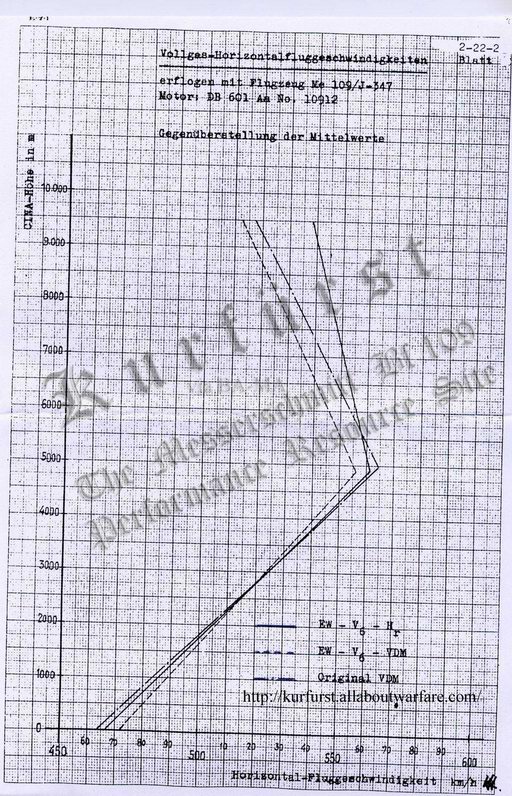 Swiss 109 E-3 reached 464 km/h with original prop ( 5 minut power) and from German test we got 467 km/h at 1.3 Ata 2400 RPM. Last edited by Kwiatek; 10-28-2011 at 09:16 AM.
|
 |
| Thread Tools | |
| Display Modes | |
|
|











 Linear Mode

