
|
|
|||||||
| FM/DM threads Everything about FM/DM in CoD |
 |
|
|
Thread Tools | Display Modes |
|
#51
 06-12-2011, 06:03 PM
|
|||
|
|||

You know what I'd like to see? That would be really "original" and probably attract more "full-real" guys and let the rookies practice taking care of their planes?
I'd like a system where each fighter base has a set selection of planes. As a player spawns the plane he selects is withdrawn from the pool and sent into action. (we already have server software that does this for IL-2) If the player returns to base, this plane will be stored in it's current state (with all damage and wear) and put into maintenance or rearm/refuel rotation to bring it up to 100% again. So now imagine you are pounding a base in an "all-out huge air-campaign online" server. The players that spawn from that base will eventually wear out their planes and decrease the operational effectivity of it. In a base-capture scenario this would be essential so that the attackers won't feel that the defenders constantly spawn in 100% airplanes when so many have been "wounded" and limped back to base.. So back on topic to the original poster, this would create a chance that when you select your plane, it could be partially repaired or have significant wear on certain components due to damage and repairs/field-repairs giving it altered performance during the next missions. It's just a piece of the larger idea of having more things play a role in the large ongoing campaign. Imagine airfields depending on factories to replenish them with brand new aircraft, ammo, fuel, spare parts etc so that it would be essential to protect these factories in order to keep the war going! Raiding trains/shipping would also cause the amount of supplies that make it to the frontline to decrease. World war II online anybody? Yes, but in theory it could be applied with success here too 
Last edited by Strike; 06-13-2011 at 10:42 AM. 
|
|
#52
06-12-2011, 11:56 PM
|
|||
|
|||
|
Quote:
Quote:
Great suggestions in both cases 
|
|
#53
06-15-2011, 07:50 PM
|
|||
|
|||
|
Inspections
In Nov 1940, the Merlin XX was given "official" approval to use 12lb/3000rpm but strip inspections were not required after its use:
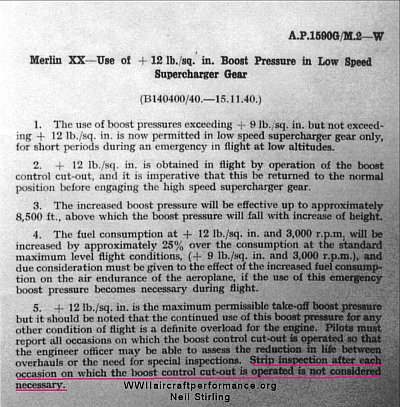 The Merlin 60 series engines were cleared for 15 and 18lb boost for combat and again strip inspections were not required after use:  An oil filter check was recommended, which probably took about 10mins. The above data is from the Spit 9 Pilot's notes and from a Merlin 60 series maintenance manual. Last edited by Seadog; 06-15-2011 at 08:56 PM.
|
|
#54
06-15-2011, 10:35 PM
|
|||
|
|||
|
Quote:
|
|
#55
06-15-2011, 11:13 PM
|
|||
|
|||
|
Quote:
|
|
#56
06-16-2011, 02:28 AM
|
||||
|
||||
|
Quote:
The engine must be inspected according the document you just posted. It clearly states the engineer must asses the reduction in life of the motor from using emergency boost. That means done by performing an oil analysis, oil change, compression check, and overall inspection of the condition of the motor. They might check the crank play as well. All of that only takes a few hours to perform and will tell a mechanic the health of the engine and it requires a reduction in life. For example, if the compression check ends up with a cylinder not making the correct compression values or the composition/type of the metal in the oil will tell a mechanic if the engine life is nearing its end.
|
|
#57
06-16-2011, 07:20 AM
|
|||
|
|||
|
Quote:
|
|
#58
06-16-2011, 09:33 AM
|
|||
|
|||
|
Well if my car manufacturer would hve include in normal servicing the check of my "Oil filter" as soon as I passed 4000 rpm well... I wld hve run directly to buy a full set of spare engines
What do you think they were looking for ?
|
|
#59
06-16-2011, 12:47 PM
|
||||
|
||||
|
Quote:
You have many misguided conceptions about airplanes. Have you ever owned an airplane? Of course not. You would know this is standard when changing the oil. Every time you change the oil, you cut the filter apart, examine the filter element inside and analyze the oil. A new engine makes metal and once broken in, an engine makes metal when something is wrong. This metal comes from many different sources in the engine and a mechanic can tell what is going on with your engine from it. Steel shavings for example generally represents cam wear, valve issues, or ring wear. Aluminum is generally bearing wear. Small flakes of aluminum, depending on the amount is normal or can be excessive. It all depends on the engine type being analyzed. Chunks of metal are of course very bad. A sample of the oil is then taken and sent to a lab for microscopic analysis. Yes, It was a requirement to inspect the engine after each use of emergency power. It was an overload condition for the motor and the reduction in service life had to be assessed by a mechanic and the use of it logged before the aircraft was returned to service. Combine that with compression checks and an overall inspection will tell a mechanic much about the health of an engine. That is pretty much what is done every year during annual or every 100 hours for commercial/military aircraft to gauge the airworthiness of the aircraft. Those are the facts based on the documents you posted. Nowhere does the fantasy notion that the Merlin could run in an overloaded condition for as long as necessary exist. It was limited and it was tough on the engine when it was used. The use of Emergency Power had to be logged, the engine inspected, and upon passing that inspection returned to service. It is that simple, bud. Last edited by Crumpp; 06-16-2011 at 12:50 PM.
|
|
#60
06-16-2011, 04:55 PM
|
|||
|
|||
|
Quote:
In the BofB the average fighter never survived past 100 hours. This is not civil aviation and trying to look at the battle, where the average pilot had a high certainty of death (probably 25 - 40% in RAFFC) as the same as a flying a light aircraft under VFR conditions is ludicrous. No pilot gave a damn about the engine on an aircraft - that aircraft existed solely to destroy the enemy and bring the pilot back safely. RAFFC had lots of spare aircraft and spare engines and pilots had no qualms about expending them at a furious pace: RAFFC lost about 2.5 SE aircraft per pilot fatality. Pilots could and did run engines at 12lb/3000rpm for a long as they needed to, and in the final analysis, no one really cared, as long as it gave them the edge in combat, which was why the RAF changed over to 100 octane fuel. A Merlin III will run at 12lb/3000rpm until the fuel runs out. Given a sufficiently large sample size, this will result in a modest increase in in-flight engine failures, but fuel consumption considerations will always be uppermost in the pilot's mind given the low endurance of these aircraft, and this will be the primary limiting factor.
|
|
| Thread Tools | |
| Display Modes | |
|
|


 Linear Mode

