
|
|
|||||||
| FM/DM threads Everything about FM/DM in CoD |
 |
|
|
Thread Tools | Display Modes |
|
|
|
#1
 05-06-2011, 04:34 PM
|
|||
|
|||

Quote:

|
|
#2
05-06-2011, 05:32 PM
|
|||
|
|||
|
Quote:
There is an awful lot of rubbish written about the Spitfire's wing. It has a pretty elliptical planform, but it also has washout, so it doesn't have an elliptical lift distribution. In fact, if you look at the early project drawings, you'll see that it started out with straight taper and four guns. The elliptical planform came in when the Air Ministry decided that they wanted to increase the armament, first to 6 guns and then to 8; going to an elliptical planform provided the structural depth required to accommodate the extra guns outboard. This is covered in some detail in Spitfire The History by Morgan & Shacklady IIRC... The real genius of Mitchell's wing design was that he realised that a low t/c would result in good high speed performance; the Spitfire had the highest tactical Mach number of any WWII fighter, and could not be out-dived by any aircraft under control until the advent of the XP-86 in 1947. It certainly wasn't delicate: it had one of the highest limiting speeds of any WWII fighter; 450 mph EAS for the Merlin Spitfire's wing, and somewhat faster for the Griffon Spitfire (IIRC Henshaw states 520 mph; but this is probably IAS assuming about 20 mph position error; Henshaw dived Merlin Spitfires to 470 mph IAS routinely as part of their production testing, and from what I can gather this was because the position error was assumed to be 20 mph IAS at this speed). That's not what I'd call a flimsy wing. Furthermore, we know that the absolute load factor that the Spitfire's wing could take was >>10 g; the RAE high speed flight had an unfortunate habit of breaking props & reduction gears away from their PR.XI Spitfires in high Mach number dives, with extensive instrumentation aboard, and rather impressive figures (c.12 IIRC) were recorded without structural failure (although the aeroplane was comprehensively bent and subsequently scrapped). The main problem with the Spitfire's wing was that it was hard to build because it's a collection of compound curves. It was also uncomfortably thin for carrying the armament required. Naturally being hard to build, it was also hard to repair in case of battle damage. But as for the amount of damage it could take, I haven't seen anything like as much gun camera footage of Spitfire wings being knocked off, even by cannon fire, as I have of other types. Of course, there's an obvious bias problem with guncamera footage, because there's relatively little German footage. But the Germans undoubtedly had big guns, so they'd arguably have more chance of dismantling aeroplanes for the camera than for example the Americans.
|
|
#3
05-06-2011, 06:27 PM
|
|||
|
|||
|
Did I say that I luve yo ?
 (quoting AB (quoting AB  ) i am so glad to read you. ) i am so glad to read you.let's go a step behond if you don't mind : The elliptical theory is a misunderstanding of a Math tools applied to aero. It does not hve a real bckgrd unless with biased assumptions. The fact is (as stated by Vip above) that thickness ratio and the wonderful Merlin made the spit what it was as a real performer. And the all genie of R. Mitchell was to build the Spit as a weapon platform that any average pilot could use and perform where German's Nazi kept arguing with their elitist theory (the UberMensh bulls***etc...). The result was that the 109 was harder to perform than the Spit or the Hurri.... As a side note lets say that it is sad that the elliptical wing was made as a brand mark for vick-Sup. IMHO it leads to the rapid demise of the Supermarine design bureau as soon as the war ended (mid 50's). It is also funny to see how history can repeat itself nowadays in Eu But this is way out of topic ~S!
|
|
#4
05-06-2011, 09:42 PM
|
|||
|
|||
|
Viper, you know that I respect you because of your factual approach, and yes, there are a lot of misconceptions about the Spit wing design, but according to a gentleman in the UK who owns and regularly flies his Spit MkIX, his Hurri IIb and P-51D, the maneuverability of the Spit is unparalleled, simply because its wing behaves and performs better, albeit being more prone to torque along its span and flex ("the whole plane feeling is of extreme agility and flimsiness, it was obviously an aeroplane that has been based on a sport design and not conceived for war").
As for wing sturdiness, I have walked to the wingtip of a Mustang without the plane making a single movement, but you wouldn't be able to do the same on a Spitfire. A cannon strike on the single spar Spit wing is more likely to do more damage and above all weaken the structure enough to cause a fracture than on a robust Mustang double spar. Let's not forget that a Mustang is almost twice the weight of a Spitfire!
|
|
#5
05-06-2011, 11:16 PM
|
|||
|
|||
|
Walking to the wingtip without making move the plane (Mustang) is barely an indicator of the wing strength. I'd say it didn't move because the landing gear is set so much more apart from each other in a P51 than in a Spit that made the difference here.
One thing is fact which in turn is exploited today on purpose for modern fighter design but which also extends to other domains: The less stable a device is the more prone is it to change its state. This principle can be exploited in a beneficial way. If you make something instable it is more easier to move around. For instance designs like the Eurofighter is instable and only kept on course because of computer software. This inherent instability allows to be more manoeuverable than a stable plane because anythings stable will tend to maintain its current status and is highly unwilling to assume another state (that is another attitude or flight direction). So if the Spit is as manoeuverable it is likely on the edge of stability and thus somewhat nerveous.
|
|
#6
05-07-2011, 12:35 PM
|
|||
|
|||
|
Quote:
I have a report of a proper Mark IX (ie. Fighter) dive trial, and it shows exactly the same symptoms of loosing control as any other fighter above 0.80 Mach. Add to that the instruments were also inaccurate at these speeds, and you have a myth liked by fans, but with very little root in reality.
|
|
#7
05-08-2011, 01:43 PM
|
|||
|
|||
|
For what it's worth... here is an interview with a Battle of Britain Ju87 pilot in which he says a Hurricane could hang on the tail of a Stuka in a sustained turn but a Spitfire was too fast.
|
|
#8
05-10-2011, 12:17 PM
|
|||
|
|||
|
Quote:
The Spitfire Pilots Notes put the dive limit at 450 mph IAS (after position error; so really it's more like CAS but without the modern compressibility correction) or what was effectively Mach 0.85, the limit being defined by a lookup table due to the absence of a Mach meter. I would suggest that Eric Brown is probably the best reference for relative performance of fighter aeroplanes because he flew so many types. It's fine to argue instrument error when you're talking about squadron pilots diving in the heat of battle and seeing fantastic numbers on their ASI. Indeed, I'm more than happy to offer up the alleged Mach 0.92 dive by a Griffon Spitfire in the vicinity of Hong Kong post war as likely erroneous. However, RAE were a competent flight test organisation, and they were perfectly capable of correcting for compressibility. The same goes for NACA, though it is notable that the USAAF went to RAE for an assessment of the high speed handling characteristics of their fighter aeroplanes (See Wings on my Sleeve). Compressibility correction for a pitot tube really isn't that hard, especially subsonic when you can just say that gamma = 1.4. Therefore I have considerable confidence in the Spitfire PR.XI dive data showing Mach 0.89; if you look at Morgan & Shacklady you'll see that the aeroplane was rather impressively instrumented for these high speed dives. I also note that this tended to break engines due to overspeeding, resulting in several serious accidents, despite the fact that the propeller was modified to feather in an attempt to contain rpm. So I wouldn't claim that a Spitfire fighter could be safely operated by a squadron pilot at such a high Mach number. But I have no reason to believe that it was unsafe to operate the aeroplane within its published envelope (i.e. the lower of 450 mph after position error correction, or Mach 0.85), not least because pilots tend to get quite vocal if aeroplanes scare them within the published envelope, and I also have no reason to disbelieve the tactical Mach numbers quoted by Eric Brown in his various books. IIRC there may be some dive test data from a Spitfire IX showing a tactical limit of about Mach 0.83 out there somewhere. This would be fairly reasonable. AFAIK the tactical limit for the Mustang is about 0.80, Thunderbolt about 0.72, Bf-109 and Fw-190A 0.75, whilst the P-38 was only ok to about 0.68. However, my books are at home; the numbers can be cross-checked in Wings on my Sleeve, Wings of the Luftwaffe, and Wings of the Weird & Wonderful.
|
|
#9
05-10-2011, 12:31 PM
|
|||
|
|||
|
Quote:
The Germans had a lot of planes to play with, and I believe they might have produced an extensive literature on the subject, it would be interesting to hear from our German speaking friends on the matter.
|
|
#10
05-12-2011, 07:04 PM
|
|||
|
|||
|
Quote:
Quote:
 Basically I think the Mach 0.85 dive limit is arbitrary, ad hoc, ex stomach etc. - a bold guesswork that was set well before they would test the actual capability, just like many of the era's limits, though a bit bolder.. But, personally I believe the behaviour shown by fighter Mark IX BS 310 was certainly no greatly different - better or worse - than just about any WW2 fighter: controls functioned normally up to about .70 Mach, then all sorts of anomalies began to appear.. and at 0.815, there's already a longitudal pitching motion - and 0.85 is still rather far away.. 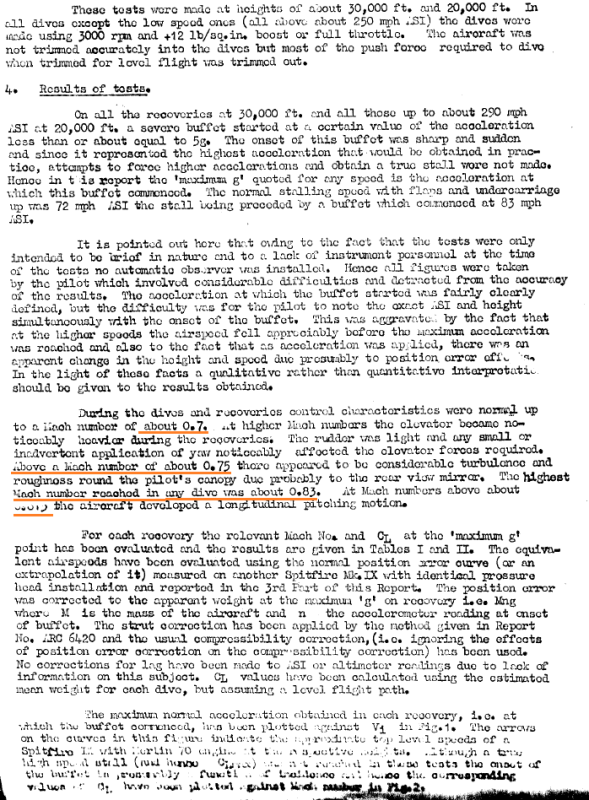
|
|
| Thread Tools | |
| Display Modes | |
|
|


 Hybrid Mode
