
|
|
#1
 02-18-2010, 04:01 AM
|
|||
|
|||
 Rolling in a Bf 110
That Fw 190 topic was so brilliant (I loved the advice, thanks guys) that I named my topic along the same name.
 Now let's see if anyone knows anything about how to fly the Bf 110, my favourite. Now let's see if anyone knows anything about how to fly the Bf 110, my favourite.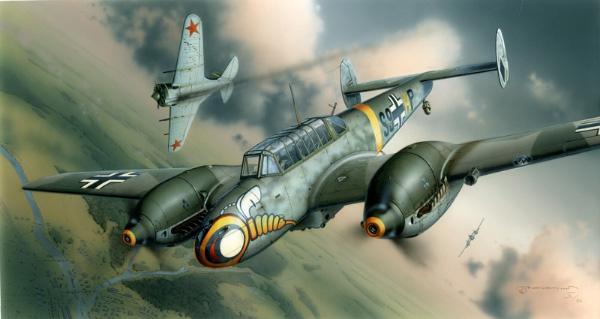 I have only found A SINGLE GUIDE on how to fly it - the WWII online wiki article. Nothing else. Here it is (and it is not bad, but there should be more out there): http://wiki.wwiionline.com/index.php/Bf110 Surely we have better information available so many years later. Aces here have more flight time and experience than any real WW2 pilot had, and the benefit of all the experience preserved from the WW2 pilots. I imagine that P-38 flying tactics can be applied to the Bf 110 to some extent so feel free to share that if you know anything about how to fly the P-38. The planes are not that dissimilar. The 110 is a bit less agile while having a rear pair of eyes and a rear firing gun position. Climbs worse too and all that. But still. To cover situations I commonly experience. What to do when... 1. Having lots of altitude above enemy fighter. How to bounce? Both if already detected and if not detected.Help me Obi-Wan Kenobi. You are my only hope. Last edited by MikkOwl; 02-18-2010 at 06:09 AM. 
|
|
#3
02-18-2010, 03:03 PM
|
||||||||||||||
|
||||||||||||||

Hello MikkOwl. I know a little bit about the 110 so I will try to help you with what I can answer.
Quote:
1- General Flying characteristics : - Speed : 110 is slower at all altitudes. It retains energy far worse and it can dive less quickly. i. VnE 110 is 700 kph. This reduce its efficiency in BnZ but you can still do things with that. ii. Cruise speed is slow. Max IAS speed is 490 kph on the deck. iii. Stall speed is pretty slow : about 150 kph with all out. You can indeed use it in combat to let the bad guy overshoot. iv. Climbs worse than P38 v. Dive worse than P38. - Manoeuvrability : Decent in turns actually. If you know how to handle it you can follow P-47s and P-51s easily in turns. You can follow a 38 and even slightly a Tempest. Forget about the Spit, of course, except if you are nearly out of fuel and he has 100% fuel J. P38 manoeuvres generally as good with equivalent speed. On one engine, the 38 has definitely the edge. 110 on one engine will fly at 220 – 240 Kph. P38 can run at 350 and even take altitude… - Endurance : The 110 can carry a lot of fuel but of course, the more fuel the less manoeuvrability. 50% gives you roughly one hour of flight running at 105% with rads on auto, so in close dogfight servers like WC, even 25% is enough. It’s just a bit of management to do. 2- Weapons and protection - Armor : The 110 is a real tough bird, especially compared to the 38. It can take a lot of punishment and still go back to base (personnal experience is going in that direction). 20 mm of the Tempest is the biggest threat, otherwise it can take a dozen of not converged 20 mm guns and loads of .50 cal. Good point for the bird, the control cables are the best protected in the game. You’ll nearly never get them cut due to enemy fire, which allow you to bring back heavily damaged planes. Weak spot of the 110 compared to the 38 : engine fire. When a 38 engine catches fire, the 38 can fly forever. When a 110 engine catches fire, you have to try to extinguish it the fastest possible, or the fuel tank will leak, then burn and finally explode (usually short after the fuel reaches the empty level). - Armament: the 110’s strong point compared to the 38. Take always the twin 30mm guns, forget about the 2x20mm gunpod. If you can’t hit with 4 guns, 6 wont help, and the gunpod decreases the top speed and manoeuvrability of the 110 in a way you can’t allow in a competitive server. - Rear gunner : another edge over the P38. Don’t dream, if an enemy is in your six, he’ll outmanoeuvre you in 80% of the cases. The rear gunner is then a precious ally even if you usually have to do the gunning yourself because it aims so bad even in straight lines. Aim at engine of liquid cooled fighters so they start burning or at the cockpit of air cooled engine fighters and pray for a PK. Rear gunner is also very good to improve your SA, not every fighter has the luxury to have 2 pair of eyes. Ok, now I will try to answer more completely about your other questions. Quote:
110 is not a lonewolf’s plane. While in the 38 you always have a good luck to escape after a missed BnZ, 110 has not this chance. It bleeds E like mad as soon as you touch the stick, it has drag caused when you compensate for the couple created by the not contrarotative engines, etc… You are basically slow. The 110 is very powerfull flown with 1 wingman at least (another 110 is good too). Best I’ve seen was 5 110 vs 2 Spits, 2 51 and 1 Tempest meeting at 5000m. The 110s got all the enemy fighters vs 1 damaged and 1 lost (crew bailed). This was done on Warclouds a few years ago already. This was achieved because of : - good team work - good SA - excellent firepower - Teamspeak The tactic is vital ! If you can pair with other types of wingmen, this is good too. Quote:
Quote:
My 2 cents, just find protection. If you want to pair with me, I fly mostly on the Warclouds server at europeean evening times. S. Oktoberfest
|
|
#4
02-18-2010, 03:07 PM
|
|||
|
|||
|
Oktoberfest, I have not read everything yet (obviously) but I want to give you a big thank you already, and telling you that this is my Dicta Boelcke
 I posted the same topic on the UBI forums (where a heated discussion is going on, interesting) and someone early on said this: "You might want to ask a guy named Oktoberfest about flying the 110 at the WarClouds forums; afaik he has no trouble dealing with P51s, Tempests or late Spits. ". I said I flew only on war clouds and that I had an account there, and would try to ask you. And look here, already For anyone wishing to see how that discussion is going, have a look: http://forums.ubi.com/eve/forums/a/t...3/m/9291013338 Will link to Oktoberfest's marvelous feedback from over there in a second. EDIT: Added in some data I was collecting for better understanding of the difference in Mk 108 package vs Mg 17 package: Some data collected on the different gun packages. The 151/20 listed are the default lower-nose installation, and not the gun-pod. Included for comparison. MG 151/20 x 2 650 rounds total 24 rounds per second Total weight (not including attachment assembly/feed stuff/links) = 204.4kg of which 119kg is ammunition (and how much ligher one will be when no more ammo). Combined fire power (damage it can inflict per second): 384 For how long: 27 seconds Total carried fire power: 10 368 Mg17 x 4 4027 rounds total 80 rounds per second Total weight: 141.5kg, of which 100.7kg ammunition. Combined fire power: 80 For how long: 50.3 seconds Total carried fire power: 4027 Mk 108 x 2 270 rounds total 21 rounds per second Total weight: 245.6kg, of which 129.6 is ammunition. Total fire power: 1160 For how long: 12.9 seconds Total carried fire power: 14 964 Mk 108 instead of Mg 17 option adds 104.1 extra kilo, 73.6% heavier (about the same weight as all the ammo for the Mg 17's), but when the ammo is out (and it happens fairly fast) it weighs 116kg, 25kg less than the fully loaded Mg 17 load out, or probably about the same with the same amount of shooting. Last edited by MikkOwl; 02-18-2010 at 04:29 PM.
|
|
#5
02-19-2010, 05:55 AM
|
|||
|
|||
|
And here i was about to tell you "maybe Oktoberfest will see this and chime in, he'll be all or most of the advice you'll ever need"
I don't regularly fly online, but when i do i prefer full switch servers and in these cases you come across some very knowledgeable folk. I still remember you dogfighting spitfires in a 110 at 8km and winning Oktoberfest, despite the inferior aircraft and the "grenade laucher" ballistics of the Mk108 shells  In fact, if there was one piece of advice i could give you from flying the 190 that could be also applicable to the 110, is that you shouldn't scoff at the Mg151s. Set your convergence to 700m and try out some long range shots, once you get familiar with it and the amount of leading the target required, you'll be able to score hits at ranges almost nobody expects you to. Couple this with the fact that a small control/course deviation of your aircraft will translate to a bigger course deviation for your bullets and it's obvious that if you can shoot from longer ranges you don't need to maneuver that hard. This is a serious advantage when you have a slower plane but also have more guns and close to half a minute of ammunition. Especially so if you consider Oktoberfest's advice that you have to get the kill as early as possible and even use head-on attacks to prevent the engagement from dragging on. Setting a long convergence on the M151s you could easily score crippling damage way before the other guy is in range. Then, if he's still coming at you you can let loose with the 108s. Or he might dive out of the fight and give you a chance to follow, or break to the side in which case you can kick some rudder and start spraying in front of him, etc. The important thing is not so much how it plays out, but the fact that (with the notable exception of the P47) most or all of the high-altitude allied fighters can be put out of action on a head on attack by a single 20mm hit, due to their liquid cooled engines. If you can shoot further out with the 20s, it means you either got the kill outright or that even in the worst case scenario the other guy has suffered some kind of damage and is on the defensive. It's like two knights jousting, the guy with the longer spear will win 9 times out of 10. Mind you, i'm not saying the 108s are not good, all i'm saying is that if you play around with the convergence settings you could have a long range option and a short range option. Essentially, i use the Mg151s as "assault rifles" and the Mk108s as "close range shotguns" against the big guys 
|
|
#6
02-19-2010, 06:12 AM
|
|||
|
|||
|
On the Fw 190, the closest pair are in the wing roots, maybe 3 meters apart, while the outer pair are even much further. On the Bf 110, maybe 40-70cm between all of them. I set the convergence to maximum, 1000 meters. The inaccuracy in the shells themselves are bigger than the distance between the barrel, and having convergence makes them cross each other's path outwards, the same disadvantage that wing cannons get (but less extreme). I am sure that in reality they used no convergence at all, since it was so close, and it was about cannon shells anyway.
The longer the range, the more effective the larger caliber shells are. The problem is of course, hitting anything. The 108 shells have low initial muzzle velocity, but their massive weight makes them overtake the 151/20's (which slow down faster from air resistance) after a few hundred meters, albeit with more projectile drop. I love the nose mounted weaponry, and I love even more not having a propeller to have to sync-shoot through! Firing both 151 and 108's at the same time seems to give no problem with stability of the plane, and their different paths (elevation wise) and large ammo supply increases the chance of a (brutal) hit. The technique I am working on in general to hit a plane of imprecise range and speed, when in 6 o-clock true chase behind him (he running away) is to walk the fire upwards. A 20 or a 30 is bound to come down on his plane if he's flying straight. They certainly have the speed advantage in later war scenarios, but having this firepower makes it possible to have a big shell catch up with them real fast before they get out of range Absolutely though, the 151's are potent weapons. But the 30's are even much more potent, and they get to the target as fast as the 151's if there's a few hundred meters involved. I'm going to try to learn how to shoot both of them at any ranges.
|
|
#7
02-19-2010, 09:36 AM
|
|||
|
|||
|
Hello MikkOwl,
the good thing with mixing 20mm with 30mm rounds when you fire is that the paths of the shells are different, which means that you can spray on a wider area. It depends of course of the form and of the distance of the engagement, but I often fire with all cannons together. I've made a track for you so you can see roughly how I fly. You'll see that TEAMWORK is essential ! And I was always on comms with Reich. Last edited by Oktoberfest; 02-19-2010 at 09:38 AM.
|
|
#8
02-19-2010, 09:41 AM
|
|||
|
|||
|
Thank you very much. Downloaded already. Will watch later today.
Printed your big nice reply with all those answers too, and will keep it around at all times when flying the 110 for quick access.Currently busy working on that Multi-Throttle program (version 4.0, I really want to get it together and released already). Makes flying the 110 all the more fun with the split throttles and, in version 4.0, individual prop pitch too. Intend to learn how to fly the G2 with manual prop pitch and follow more realistic procedures and settings. It really sets the blade angle too, not the desired RPM of each engine so overrev happens easily if diving and not adjusting. As far as I know the C-2 and C-4 models did not have automatic pitch, and that's what we should be getting for Storm of War. Might as well have the habit already.
|
|
#9
02-19-2010, 10:23 AM
|
|||
|
|||
|
I agree on everything you say guys. The problem for me is not the range or speed of the 108s but the drop, especially if high pitch values and G loads become a factor.
I can hit targets that are slower than me just fine, especially if they are something big (like a bomber that i happen to approach from the sides, heck you can knock the rudders off of B17s even if you happen to shoot higher and miss the fuselage). However, in that case it's not only that the enemy target is moving in a predictable way, it's also that my airframe is on a more or less stable run. I usually make a curved approach, turning into them from their 2/10 o'clock, so as i get closer i shoot and exit to their 5/7 o'clock. The thing is, before firing i quickly roll level with the plane defined by the target's wings. In all of this, at the moment of firing i have a stable airframe flying almost straight and level and pulling almost no Gs, so i can score good hits. It might be just a split second, but it definitely is there. However if i take a fighter/heavy fighter with 108s against another fighter, i don't only have to track a wildly maneuvering target with a limited ammo supply, but my airframe is also unstable as a result of following him. That doesn't mean the 108 is crap, it means that i'm crap with the 108s against small targets  It's why i always fly 190s even when i want to go high, where a 109K4 would probably make more sense.
|
|
#10
02-22-2010, 09:09 PM
|
||||||||
|
||||||||
|
Quote:
I was aware of there being major differences, but I was thinking of the P-38 as in used against Zeros, not quite the War Clouds type situation. A maybe not entirely different situation to how the Bf 110 C models were like during the Battle of Britain (Mainly slower Hurricanes everywhere that turn much better but much slower and worse armament). I thought, and still think, that cross tactics could be useful (not least in the terms of twin engines and if there's any maneuvers possible with them apart from getting out of spins and to help out the rudder at very slow speed vertical maneuvering).Quote:
"Instantaneous turn rate describes maximum g turns which cause a loss in energy, either in the form of speed or altitude. This loss may be compensated for, to a degree, by increasing thrust, known as "excess specific power." This usually occurs during hard turns or even harder breaks. Only by turning the aircraft at its best "sustained turn rate" can the aircraft maintain its specific energy."In general, it seems that it is possible to very quickly change the attitude (pitch) of the plane at any time (changing foremost angle of attack), which seems very useful for bringing guns on someone. But also if the 110 starts turning pretty fast, this should be exploited too. The one thing that it really can't do well, like you have pointed to, is sustained maneuvering. It will just slooooow down when pushed hard. Emphasising the 'burn' in "Turn n' Burn". The Fw 190 does good instantaneous turns (and of course amazing rolling) and in that thing, doing several shorter hard maneuvers (or jinks we can say) is useful for throwing off someone's pursuit and aim. Limited in the 110, but at least it's something. Also, nosing down hard, with or without some turning involved, must surely be something since it does perform it initially very quickly, while slowing down in the process (and takes a while to red out).Quote:
What is the reasoning for Split-S in particular? That it loses speed fast and has decent turn radius (which is fine for Split-S where you don't want to hit the ground)? If so, maybe the opponent follows it up with a Shit-S (Split-S gone wrong, flight into ground)... It rolls on the slow side, but not that bad I think, with rudder and other things thrown in, as long as there's speed. To add to it - isn't the ideal maneuver to add to the Split-S specifically a snap-roll? Just quickly flip 180 and pull back hard. Faster than trying to roll conventionally. Quote:
Also, the question of survivability: the 110 seems a lot larger than the average fighter (not to mention small ones). It may absorb more damage, but I wonder if there's much difference as it will get hit more due to size. My own experience does suggest it can get shot up a lot. I have a tendency to lose my Revi Gunsight more than other planes if anything. The glass-house cockpit is a bit bothersome, but probably no different from any other fighter. The 110 is a hell of a lot tougher than the P-38 for sure. 38 always gets catastrophic failiure instantly, very different. Being so large makes it hit more too. Quote:
Quote:
). I agree, team work and communication is much more important than the planetype. Firepower always mixes well with team work especially while maneuverability and speed I think is outmost important for lone wolfing.Quote:
Quote:
|
 |
| Thread Tools | |
| Display Modes | |
|
|


 Linear Mode

